Robotic pool cleaner setup, diagnosis and performance checks for Melbourne pools.
Pool Robot Cleaner Service in Melbourne
If your robotic pool cleaner keeps missing dirt, tangling its cable, sliding off walls or stopping before the pool is actually clean, the problem is rarely solved by running the same cycle again. Melbourne pools often need a practical check of both the robot and the pool conditions around it.
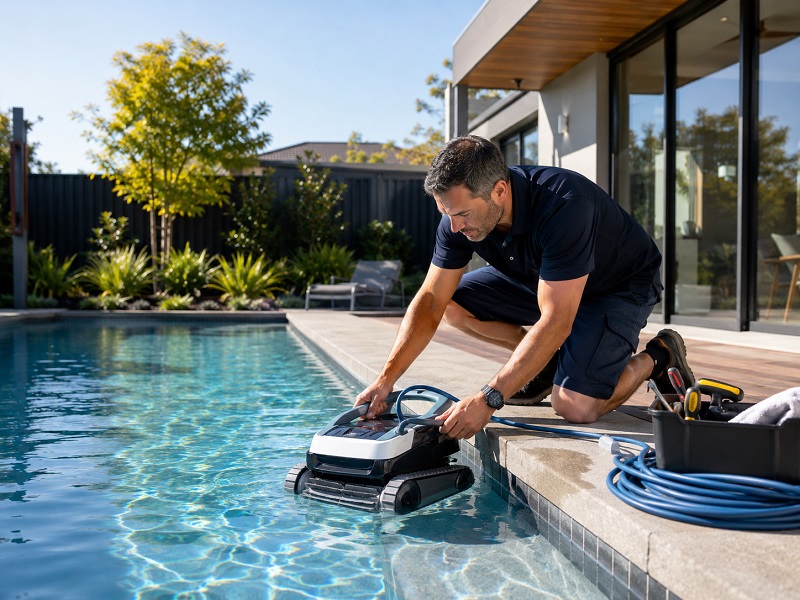
Litra Pool Care helps with robotic pool cleaner service, setup and diagnosis across Melbourne. We check the cleaner, power supply, filters, cable behaviour, selected cycle, traction, debris pattern and pool condition so you can understand whether the issue is setup, maintenance, wear or a real equipment fault.
Short answer: a robotic pool cleaner that still runs but leaves dirt behind may not be broken. Common causes include clogged or mismatched filters, overloaded baskets, cable twist, poor start position, worn brushes or tracks, fine dust after weather changes, slippery pool surfaces or a cleaning routine that does not match the debris load.
When robotic cleaner service makes sense
This service is designed for pool owners whose robotic cleaner still operates but no longer cleans properly. Some cleaners run through a full cycle and leave half the floor dirty. Some collect leaves but leave fine dust behind. Some climb one wall and then lose grip. Others stop mid-cycle, beep, overheat or keep tangling the cable until coverage becomes inconsistent.
A robot can look “broken” when the real cause is poor setup, the wrong basket or filter insert, heavy fine silt, an unbrushed surface, low traction, or a cleaning schedule that does not match the debris load in the pool. That is why we do not jump straight to replacement advice. First, we separate actual cleaner faults from performance problems caused by pool conditions.
Robot pool cleaner not working or stopping mid-cycle
Initial robotic cleaner setup after purchase, property handover or pool build
Cycle, coverage and handling setup for floor, wall and waterline cleaning
Fine dust, grit, leaves and repeated missed-spot problems
Cable tangles, weak wall climbing and reduced traction
Repair or replacement advice before more money is spent
Common signs your pool robot needs service
It runs, but the same areas stay dirty
This usually points to coverage logic, basket loading, cable memory, start position or traction problems rather than a simple power fault. A robot that moves is not automatically cleaning well.
Wall climbing has become unreliable
Weak wall performance can come from worn brushes or tracks, a full basket, restricted water flow through the unit, slippery biofilm on the surface, or the wrong mode for the shape and finish of the pool.
The cable keeps tangling
Tangles are often made worse by poor storage, repeated twist build-up, long cycles, a bad starting layout or return flows that keep pulling the cable the same way. It is not always a cable defect.
Leaves are collected, but fine dust keeps coming back
This is a common Melbourne pool complaint after wind, blossom, dust and weather changes. The cause is often the wrong filter grade, overloaded cartridges, poor brushing order or suspended fines that the robot alone cannot solve.
It stops early, beeps or feels weaker after part of the cycle
Intermittent shutdowns can point to power-supply issues, overheating, intake restriction, motor strain, swivel resistance or wear that only appears once the unit has been under load for a while.
Important: a robotic cleaner is only one part of the cleaning system. If circulation is poor, surfaces are slippery, the pool is carrying too much fine dust, or the selected basket is wrong for the debris type, the robot will underperform even when the electronics are still healthy.
How we diagnose robotic pool cleaner problems on site
We check more than whether the cleaner turns on and moves. The goal is to understand whether the fault is in the robot, the setup or the surrounding pool conditions — and whether the current unit is still worth repairing.
1. Confirm the real cleaning problem
We start with the symptom you actually see: missed areas, weak wall climbing, dust left behind, cable tangles, early shutdowns or reduced cleaning after storms and windy weather.
2. Check simple causes before blaming the cleaner
We inspect basket condition, filter inserts, intake restriction, cable layout, visible wear and the selected cycle. Many robotic cleaner complaints start here, not deep inside the motor or electronics.
3. Review traction and movement quality
If the unit is slipping, hesitating or failing on walls, we assess brushes, tracks, rollers, grip and whether the pool surface itself is contributing to the problem.
4. Separate robot faults from pool-condition faults
Fine silt, suspended dust, slimy walls and post-storm debris loads can make a healthy cleaner look ineffective. We identify what the robot can fix and what needs brushing, filtration or wider pool-care work.
5. Set up the cleaner for your pool
We review start position, cycle choice, filter setup, cable handling and the run order relative to normal maintenance so the robot is not working against the pool conditions.
Setup changes that can improve cleaning performance
There is no single “best setting” that works for every robotic cleaner and every pool. The right setup depends on the pool finish, floor profile, depth changes, steps, benches, obstacle zones, debris type and how often the robot is used. A unit set up well for large leaves may perform poorly with fine dust. A long cycle can improve one pool and create cable frustration in another.
Cycle selection
We check whether the cleaner is being run too long, too short, or in the wrong mode for the actual problem. A floor-only pass, a floor-and-wall cycle and a waterline-focused cycle are not interchangeable in practice.
Filter choice
Coarse inserts may be acceptable for leaves and larger debris but not for the fine dust and settled particles many owners complain about after wind and weather shifts. When dust performance is poor, the filter setup is one of the first things to review.
Start position and cable behaviour
Moving the start point and correcting how the cable is laid out before the run often improves coverage more than owners expect. Poor storage habits can also build twist into the cable and gradually reduce effective movement.
Run timing
The cleaner should fit the maintenance routine, not work against it. In some pools, running the robot after brushing, skimming or debris removal makes a clear difference. In others, the cleaner is being sent into a pool that is still carrying too much suspended material to finish well.
Practical point: if the robot is being used as the only answer to heavy silt, algae film, construction dust or major storm debris, expectations need to be reset. A robotic cleaner can be very effective, but it cannot replace brushing, filtration and manual cleanup in every recovery situation.
What we check during a service visit
Power supply condition, output stability and obvious cable or connector problems
Tracks, brushes, rollers and other wear points that affect grip and climbing
Basket, cartridges and internal flow path for restriction or mismatch to the debris type
Cable swivel behaviour, twist pattern and storage-related strain
Cycle choice, cleaning frequency and start-point logic
Pool shape, steps, benches, corners and obstacle zones that affect coverage
Fine dust, grit, leaves, blossom or post-storm debris profile in the pool
Signs that the cleaner issue is actually part of a wider maintenance problem
Where it makes sense, we focus on restoring useful performance rather than pushing premature replacement. Where wear, repeated faults or poor model fit make replacement the better decision, we explain that clearly rather than disguising it as endless “maintenance”.
Repair or replace: when service is still worth it
Owners often reach out when the robot has become annoying rather than completely dead. That is exactly the point where a careful inspection can save money. A cleaner with useful life left can still underperform badly because of avoidable issues such as a poor filter setup, overloaded baskets, cable memory, traction loss from wear, or a pool routine that no longer suits the debris pattern.
On the other hand, some units have reached the stage where replacement is the better use of money. Repeated shutdowns, persistent weak movement under load, multiple wear points and a poor match between the cleaner class and the pool it is serving can push the economics the other way. The value of a service visit is that you get a clearer answer before making that call.
When the robot is not the only problem in the pool
One of the most common mistakes is judging the robot only by what is still visible on the surface or floor. Fine dust may keep returning because the pool is not clearing suspended particles between cycles. Wall climbing may be poor because the walls are slick, not because the drive motors have failed. A cleaner that feels weak after storms may simply be overloaded by debris type and run order.
This is why replacing the robot without correcting the surrounding conditions often leads to the same frustration with a newer machine. After the visit, you should know what belongs to the robot, what belongs to setup and what belongs to wider pool care.
Owners with a robot that still runs but no longer cleans properly
This is the most common call-out. The cleaner is not fully dead, but the result is inconsistent enough that owners are wasting time rerunning cycles and emptying baskets without solving the cause.
New owners who want the cleaner set up correctly from the start
If a robot has been newly purchased, inherited with the property or handed over after a build, a correct setup early on helps avoid poor habits and mismatched expectations.
Pools with repeated dust, missed spots or wall-performance complaints
When the same symptoms keep returning, the useful part is checking the cause before changing settings or buying another cleaner.
Owners deciding whether the current unit is still worth keeping
If you are tired of trial-and-error spending, inspection helps you decide between repair, setup correction and replacement.
Need help with robot cleaner setup, diagnosis or cleaning performance issues in Melbourne? You can request service through the contact page or review general service information on pool equipment inspection and repair.
FAQ
This usually comes down to coverage setup, basket loading, filter choice, cable drag, start position or traction rather than a simple power fault. A robot that moves can still clean badly.
The best settings depend on the pool finish, debris type, coverage needs and how often the cleaner is run. Floor-only, wall cleaning, filter grade and cycle length should be matched to the actual job, not copied from another pool.
Weak wall performance can come from worn brushes or tracks, a full basket, restricted flow through the unit, a slippery surface film or the wrong cycle choice for the pool shape and finish.
Poor storage, twist build-up, repetitive starting layout, long cycles and return flow patterns can all contribute. Cable tangles are not always caused by a damaged cable.
Fine dust usually points to filter grade, overloaded cartridges, poor run order or suspended particles that the robot alone cannot clear effectively. This is often a setup problem, not only a robot fault.
For routine cleaning it can reduce a lot of manual work, but it is not the only answer for every pool condition. Heavy storm debris, builder dust, major fine silt and some recovery situations still need a broader cleaning plan.
Yes. Setup support can include cycle selection, filter setup, cable handling, starting layout and a practical routine based on the pool’s surface, shape and debris pattern.
That depends on the age of the unit, the wear level of the main components, repeat-fault history and whether the cleaner is still a good fit for the pool. A service inspection helps make that decision on actual condition rather than frustration alone.
Yes. Slimy surfaces, unstable water, suspended fines, poor circulation and heavy debris loads can all make a healthy cleaner look ineffective. This is why diagnosis should include both the robot and the pool conditions around it.
Yes. The best time to check it is often before it fails completely, when the cleaner may still be salvageable but is already wasting time through poor coverage, dust complaints, repeated tangles or inconsistent wall performance.
Service Area Map: South-East Melbourne, Nearby Bayside Suburbs & Selected Peninsula Areas
Tap a suburb chip to focus the map. We mainly service Carrum Downs, Frankston, Seaford, Chelsea, Patterson Lakes and nearby south-east suburbs, with selected Mornington Peninsula coverage.
Map shows the main service radius around Carrum Downs. Final visit availability still depends on suburb, access, and current workload.
Map could not load. Service areas include Carrum Downs, Frankston, Seaford, Chelsea, Patterson Lakes, Langwarrin, Skye, Edithvale, Aspendale, Mordialloc and nearby south-east suburbs.
Quick Pool Care Request
Cleaning, water testing, balancing or equipment support.
Same-day response
CleaningMaintenanceSkimmerFiltrationChlorineAlgaePumpBackwashVacuumpH LevelSanitizerBrushDebrisWater Test
CleaningMaintenanceSkimmerFiltrationChlorineAlgaePumpBackwashVacuumpH LevelSanitizerBrushDebrisWater Test


 Cleaning