Water testing and treatment planning
Free chlorine, pH, stabiliser (CYA) where relevant, water visibility and other treatment-relevant chemistry are checked alongside the apparent algae load before the treatment plan is selected.

Litra PoolCare restores light green, dark green and algae-covered pools by checking the water and filtration system before treatment. Green water is often algae-related, but colour alone is not a diagnosis; unusually clear green water or staining can indicate a different water-chemistry issue that should be checked before algae treatment is selected.
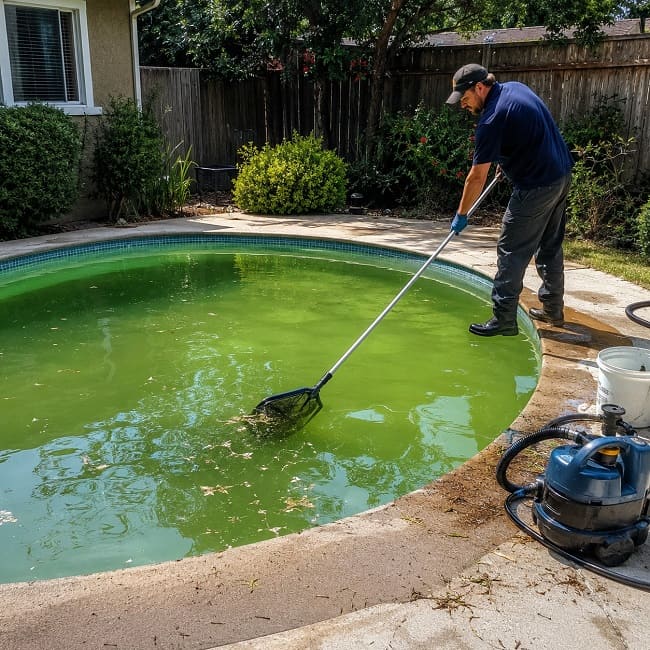
What the recovery visit includes
The exact sequence depends on water condition, debris and filtration performance.
For algae-affected pools, recovery focuses on reducing the active algae load, restoring an effective sanitiser residual and confirming that circulation and filtration can support clarification.
Free chlorine, pH, stabiliser (CYA) where relevant, water visibility and other treatment-relevant chemistry are checked alongside the apparent algae load before the treatment plan is selected.
Leaves, organic material and accessible debris are removed because they increase chemical demand and slow clarification.
Walls, steps and affected surfaces are brushed so treatment reaches attached algae and the filter can begin removing loosened material.
Pump operation, return flow, filter pressure, baskets and obvious circulation problems are reviewed during the recovery process.
Send a full-pool photo together with the equipment pad, pressure gauge and chlorinator display. This helps identify heavy debris, weak circulation, whether the filter may need cleaning or separate service, and whether a repeat visit is likely.
When algae returns after treatment, common causes include inadequate sanitiser, continued organic load, poor circulation or filtration, and water-balance or stabiliser conditions that contribute to inadequate free chlorine.
A failed chlorinator cell, low output setting, short pump runtime or chemistry that leaves free chlorine too low can allow algae to return after the initial treatment.
High pressure, blocked media, a dirty cartridge or an overloaded filter can leave fine material in circulation and keep the water cloudy.
Leaves, soil, fine silt and organic matter can keep using sanitiser after treatment and may require further removal or vacuuming.
Weak return flow, blocked baskets, suction problems or limited pump runtime can leave low-flow areas where algae survives.
The starting price is not a fixed quote for every green pool. The final scope depends on pool volume, debris and algae load, filtration performance and whether repeat treatment or another visit is needed.
Larger water volume can require more treatment product, longer circulation and additional testing before the water stabilises.
Heavy leaf load, soil, fine silt and organic material increase removal time and can continue consuming chlorine.
A blocked, dirty or underperforming filter can extend clarification time and may require cleaning or separate attention.
Dark green water, poor visibility, heavy algae or slow filtration can require re-testing, further treatment or another service visit.
If the chlorinator is not producing enough sanitiser, recovery may take longer and equipment diagnosis or repair may be needed separately.
Clear photos make the first assessment more accurate and help identify whether the filter, chlorinator or debris load may change the scope.
Green pool recovery is available in Carrum Downs, Frankston, Seaford, Skye, Langwarrin, Patterson Lakes, Chelsea, Edithvale, Aspendale, Mordialloc, Keysborough and nearby south-east Melbourne suburbs. Availability depends on route, access and pool condition, so send your suburb and pool photos before booking.
The current listed starting price is from $350. The final price depends on pool volume, debris load, filter condition, chemical demand, chlorinator performance and whether another visit is required. Green pool chemicals and additional treatment products are quoted separately where required.
No. The 48–72 hour period is a typical recovery range, not a guarantee. Dark green water, heavy debris, slow filtration, poor circulation or equipment faults can extend the process.
If algae returns after treatment, common causes include insufficient sanitiser, short pump runtime, blocked or overloaded filtration, continued organic debris, weak circulation, or water-balance and stabiliser conditions that leave free chlorine too low.
Send the pool and equipment photos listed above with your suburb. Litra PoolCare can then confirm service availability and the likely recovery scope before booking.
 Cleaning
Maintenance
Skimmer
Filtration
Chlorine
Algae
Pump
Backwash
Vacuum
pH Level
Sanitizer
Brush
Debris
Water Test
Cleaning
Maintenance
Skimmer
Filtration
Chlorine
Algae
Pump
Backwash
Vacuum
pH Level
Sanitizer
Brush
Debris
Water Test
Cleaning
Maintenance
Skimmer
Filtration
Chlorine
Algae
Pump
Backwash
Vacuum
pH Level
Sanitizer
Brush
Debris
Water Test
Cleaning
Maintenance
Skimmer
Filtration
Chlorine
Algae
Pump
Backwash
Vacuum
pH Level
Sanitizer
Brush
Debris
Water Test