On-site pool water testing in Melbourne
Measured pool water testing before chemicals are added
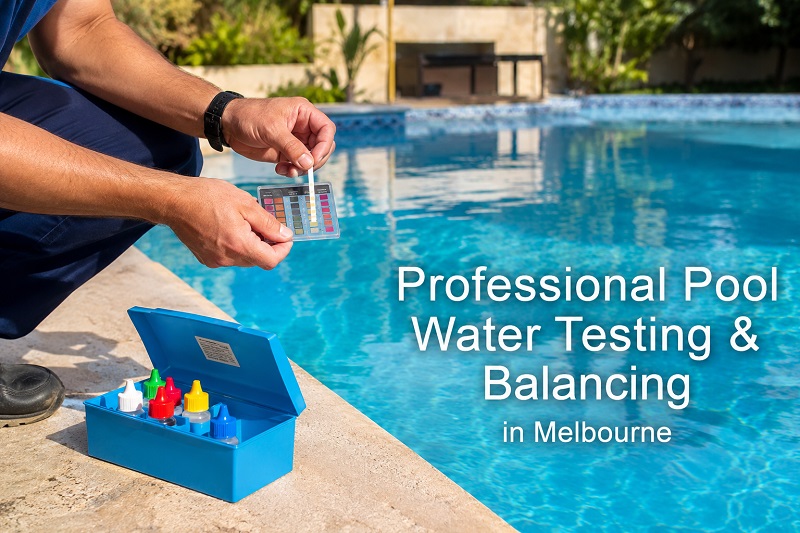
Litra PoolCare provides professional pool water testing and balancing for Melbourne pools where guesswork is no longer enough. The visit checks the readings that affect sanitation, clarity, swimmer comfort, pool surfaces and equipment performance before any chemical correction is recommended.
Direct answer: professional pool water balancing means testing the main chemistry values, reading them together, then adjusting sanitiser, pH, alkalinity, stabiliser and hardness in the right order. The goal is controlled water, not simply adding more product.
Balanced readings
Free chlorine, stabiliser, pH, alkalinity and calcium hardness are interpreted together, not as isolated numbers.
Clearer water decisions
The visit helps identify whether the first move should be chemical correction, filter work, circulation checks or equipment repair.
Surface and equipment protection
Poor balance can scale salt cells, reduce heater efficiency, stain surfaces and increase corrosion risk around fittings.
Recorded service logic
Readings are checked, explained and used to guide the next action instead of chasing cloudy water with random dosing.
What is checked during a water testing visit
- pH and how stable it is likely to remain between visits.
- Total alkalinity and whether it is driving pH movement.
- Free chlorine and combined chlorine, where the test method allows it.
- Cyanuric acid / stabiliser for outdoor pools exposed to Melbourne sun.
- Calcium hardness and scale or corrosion tendency.
- Salt or TDS where the pool uses a salt chlorinator.
- Water temperature and visible water condition.
- ORP or sensor behaviour where automation or dosing is installed.
Why water balance should be checked before dosing
Sanitation is not one number
Low chlorine is not always caused by the same fault. It can come from high demand after rain, low stabiliser, dirty filtration, short pump runtime, weak salt cell output or poor circulation. Testing helps identify the real starting point.
pH and alkalinity work together
If alkalinity is pushing pH upward, simply adding acid again and again may not hold the pool stable. A proper reading shows whether the pool needs staged correction rather than one large dose.
Cloudy water can be mechanical
Cloudiness can remain when filtration is weak, filter media is dirty, circulation is poor or chlorine never stayed effective long enough. A water test is often the first step before blaming the chemicals.
Salt pools still need balancing
A salt chlorinator produces chlorine, but it does not automatically manage pH, alkalinity, stabiliser, calcium hardness, salt level, filter condition or runtime. Salt pools still need measured water control.
How the visit works
Check recent changes
We look at rain, top-up water, heavy swimming, cloudy water, algae, low chlorine, high pH, pressure changes or chlorinator warnings.
Test and interpret
Core readings are taken and interpreted as a system. Where relevant, visible flow, filter condition and chlorinator output are also reviewed.
Correct in sequence
Sanitiser, pH, alkalinity, stabiliser and hardness are handled carefully so one correction does not create the next problem.
Choose the next service path
If readings point to a filter, pump, chlorinator or green pool issue, the next step is made clear before more chemicals are wasted.
When water testing should be booked sooner
Visible water problems
Book a test sooner if the pool is cloudy after dosing, algae appears on walls or steps, chlorine keeps dropping, or the water has changed after rain, overflow or heavy use.
These symptoms often need both chemistry and circulation checked.
Equipment-related symptoms
Low flow, rising filter pressure, salt warnings, weak chlorinator output or frequent pH movement can all affect water balance. Testing helps confirm whether the problem is chemical, mechanical or both.
This avoids treating an equipment fault as a dosing problem.
Related services
If the water test shows that the problem is not only chemical balance, these related services help move from readings to the correct repair, cleaning or recovery path.
FAQ — pool water testing and balancing
Q
How often should a Melbourne pool be tested?
In warm months, weekly testing is usually sensible for residential pools. In cooler months, many pools can be checked less often, but the timing should change after storms, overflow, heavy swimming or visible water changes.
Q
Why is a test strip not always enough?
A strip can be useful for quick checks, but it can miss the wider operating picture. A professional visit looks at how the readings interact and whether the equipment is helping or working against the water balance.
Q
Do salt pools still need balancing?
Yes. Salt systems create chlorine while water is flowing through the cell, but they do not remove the need to manage pH, alkalinity, stabiliser, calcium hardness, salt level, filtration and runtime.
Q
Can testing explain recurring green water?
Often, yes. Recurring green water may be linked to low effective chlorine, a CYA mismatch, poor circulation, dirty filtration, short runtime, a weak chlorinator or organic load after weather events.
Book professional pool water testing in Melbourne and get the readings interpreted before more chemicals are added.
Measured: pH, alkalinity, FC/CC, CYA, calcium hardness, salt/TDS, temperature and ORP where equipped.


 Cleaning