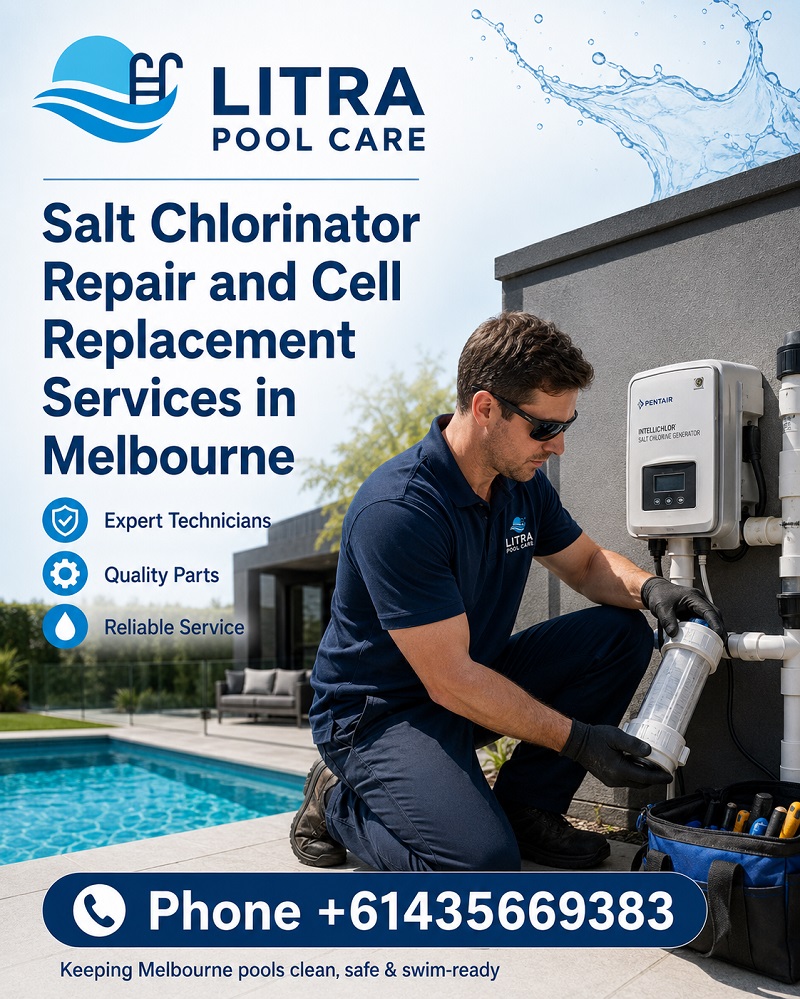
Salt chlorinator repair • cell replacement • Melbourne
Salt chlorinator repair and cell replacement service for Melbourne pools

If your salt chlorinator shows low output, throws error messages, or your cell keeps scaling up, the fix is rarely “turn it up to 100% and hope.” A salt system stays stable only when water balance, flow, cell health, and controller power are all doing their job. We identify what is limiting production, restore predictable output, and set your chlorine production and timer so you are not chasing readings every day.

We reference free chlorine (FC) and combined chlorine (chloramines) below because these two readings often explain why water can look fine one day and drift the next.

Salt Chlorinator Faults We Check First

How we narrow it down onsite

Most hard-to-pin-down salt chlorinator issues come from one of four areas: cell condition, water balance, flow, or controller power/logic. The job is to check whether the unit is generating during normal pump operation, not just showing a “Generating” message, and whether production is being interrupted by flow, timers, or low-temperature limits.

Symptoms and Common Causes
Symptom Most likely cause What we check / fix
Why “100% output” is not a fix

If the cell is scaled or worn, 100% output can still produce less chlorine than expected, while increasing stress on the system. The better repair path is to restore cell efficiency, check chlorine output, then adjust the timer and production settings to match daily demand.

Low output: what reduces chlorine production

Low output troubleshooting

Low output can come from several different faults, so the system should be checked before parts are replaced. A salt system can under-produce even when the screen says it is working. The most common causes are:

  • Cell scaling (calcium): a thin white coating can reduce effective plate area and choke production.
  • Cell age/wear: coatings degrade; the unit may run higher voltage while producing less current.
  • Water chemistry drift: pH, calcium hardness, and alkalinity influence scale; stabiliser (CYA) affects how much FC you need daily.
  • Low/unstable flow: dirty baskets/filter, air leaks, wrong pump speed, or flow-switch behaviour stopping generation.
  • Controller/power supply issues: poor DC output, relays, fuses, or PCB faults reducing chlorine output.
What often happens in real pools

When the plates are coated with calcium, adding salt or changing the timer often does very little. The useful first check is whether the cell can still produce normal current during pump runtime and whether the plate surface is clean enough to work efficiently.

Cell scaling: why it happens and what “cleaning” should look like

Cell scaling & cleaning

Melbourne conditions, including top-ups, rain events, warm spells, and heavy use, can push some pools into a scaling pattern, especially when pH drifts high. Scale acts like insulation on the plates and can trigger “Check Cell” or “Low Salt” style warnings depending on the model.

What we do onsite
  • Safe isolation: power off before opening the controller or removing the cell.
  • Visual inspection: plate condition, deposits, cracks, and O-rings / unions.
  • Performance check: check operating behaviour, including current/voltage where available, and test chlorine output.
  • Correct cleaning: clean only when needed and with a method suited to the cell type, then re-test output after cleaning.
Why “over-cleaning” is a problem

Aggressive or too-frequent acid cleaning can shorten cell life. If scale returns quickly, it is usually a sign of pH drift combined with higher calcium conditions. The cell becomes the first place scale shows up. The long-term solution is controlling the drivers, not repeating harsh cleans.

Cell replacement: when a new cell is the correct repair

Cell replacement (SWG cell)

If a cell is worn, a common pattern is higher operating voltage, lower current, and chlorine production that no longer matches runtime. Replacement becomes the clean, cost-effective fix when cleaning no longer restores output, or when the cell is physically compromised.

When replacement makes sense

We recommend a new cell only when output does not recover after inspection, correct cleaning, and a cell output check, or when the cell shows mechanical or electrical failure. If the controller or flow is the actual issue, we avoid unnecessary cell replacement.

Repair or Replace: How the Decision Is Made
What you see What it usually means Best next step
What we handle during replacement
  • Correct sizing: match capacity to pool volume and actual run hours, not optimistic brochure settings.
  • Compatibility: confirm controller/cell pairing and sensor connections.
  • Reset/calibration: set counters where applicable and check output after installation.
  • Leak prevention: inspect unions/O-rings, confirm flow direction, and ensure stable priming.

Controller issues: display faults, power supply, and “it says it’s on, but it’s not”

Controller troubleshooting

Sometimes the cell is fine, but the controller is not delivering stable power or is not switching correctly. Common controller-side problems include:

  • No power / dead display: supply, fuse, transformer/power module, or internal board faults.
  • Random resets / beeping / errors: unstable supply, moisture ingress, aging components, or poor connections.
  • “Generating” indicator without chlorine output: switching faults, low current delivery, or sensor misreads.
  • Sensor faults: temperature/salinity/flow sensor drift driving incorrect system decisions.
Safety and accuracy

Electrical diagnosis needs a controlled, safe process. We confirm whether the fault sits with the cell, controller, flow, or water balance before any parts are swapped.

Setting output % and timer: a practical setup that stops up-and-down chlorine

Output & schedule tuning

The correct setting is the one that matches your pool’s daily demand with your actual pump runtime. We tune settings so you do not bounce between low-FC days and over-chlorinated days.

Step 1 — Confirm circulation: stable prime, clean baskets, filter condition, and correct pump speed for the chlorinator.
Step 2 — Set a baseline runtime: enough hours for skimming, mixing, and generation during typical demand periods.
Step 3 — Adjust one lever at a time: change either output % or runtime, then observe the trend for several days.
Step 4 — Align production with demand: many pools benefit from producing during the day when UV and use drive demand.
Variable-speed pump reminder

If the pump runs too slow, the chlorinator may not detect adequate flow and will stop generating even if the timer says it is on. We confirm flow requirements and set an appropriate chlorination-speed window.

Our onsite repair process

Onsite workflow
1) Symptom confirmation: errors shown, output settings, and recent changes such as rain, backwash, salt additions, or pump schedule changes.
2) Water and flow check: circulation, baskets/filter status, visible debris load, and red flags that distort output.
3) Cell inspection & performance check: scaling, wear, connections, and generation behaviour during normal pump operation.
4) Controller diagnostics: power/logic, sensor signals, wiring, and fault isolation.
5) Repair decision: clean/restore, replace cell, or address controller-side issues, then check output after repair.
6) Output & timer tune: practical settings aligned with your pool’s demand and your pump’s actual runtime.
The result we aim for

Chlorine production that holds steady from week to week, with settings matched to Melbourne weather swings, bather load, and debris seasons.

To book, use the enquiry form on this page and include a photo of the controller screen if you are seeing repeated “check cell” alerts or persistent low output.

FAQ: errors, low output, scaling, controller faults, and timers

“Low Salt” can be triggered by reduced cell current, not only true low salinity. A scaled or worn cell, dirty connections, sensor drift, or controller power delivery issues can make the unit read low. The cell condition and output should be checked before more salt is added.

If cleaning restores output and your FC trend stabilises at sensible settings, a clean may be enough. If output remains weak after correct cleaning and a cell output check, the cell may be worn or electrically under-performing. We confirm the limiting fault before recommending replacement.

Cell life varies by brand, usage, and water conditions. The biggest life-shorteners are persistent scaling, frequent aggressive acid cleaning, and running the system at very high output for long periods to compensate for an underlying issue. Stable water balance and early repair of flow or controller faults generally help extend cell life.

Many chlorinators reduce output at lower water temperatures, and demand patterns also change. Winter can also expose borderline issues such as a scaled cell, short runtime, or low flow that were not obvious in summer. The right approach is checking clean plates, stable flow, and season-appropriate settings.

In most cases, swimming depends on whether your water chemistry is in a normal range and the pool is circulating properly. After service, we check that circulation, chlorine level, and settings are safe before giving final guidance. If any water-balance correction is needed, follow the instructions provided on the day.

Common triggers include scaling on plates, worn coatings, poor connections, sensor misreads, or controller-side power delivery problems. We check whether the system is generating during pump runtime and whether the warning matches what the unit is actually doing.

Yes. If pump speed is too low, the chlorinator may not detect adequate flow and will stop generating or cycle on/off. A stable setup includes a dedicated chlorination-speed window and a schedule aligned with demand.

Salt Chlorinator Repair & Cell Replacement — Melbourne

Low output, “Check Cell”, “Low Salt” warnings, scaling, or intermittent faults? We separate a worn cell from controller, flow, and water-balance problems, restore steady chlorine output, and set your output and timer correctly.

  • Error-code diagnosis & output check during pump runtime
  • Cell inspection: scaling, wear, unions & connections
  • Cell cleaning when appropriate, or correct-size replacement
  • Output % + pump timer tuning, including variable-speed flow checks
Melbourne & nearby suburbs. If you are seeing repeated “Check Cell” alerts or persistent low output, include a photo of the controller screen in your enquiry.

Service Area Map: South-East Melbourne, Nearby Bayside Suburbs & Selected Peninsula Areas

Tap a suburb chip to focus the map. We mainly service Carrum Downs, Frankston, Seaford, Chelsea, Patterson Lakes and nearby south-east suburbs, with selected Mornington Peninsula coverage.

Map shows the main service radius around Carrum Downs. Final visit availability still depends on suburb, access, and current workload.
Map could not load. Service areas include Carrum Downs, Frankston, Seaford, Chelsea, Patterson Lakes, Langwarrin, Skye, Edithvale, Aspendale, Mordialloc and nearby south-east suburbs.
Cleaning Maintenance Skimmer Filtration Chlorine Algae Pump Backwash Vacuum pH Level Sanitizer Brush Debris Water Test
Call Now Button