


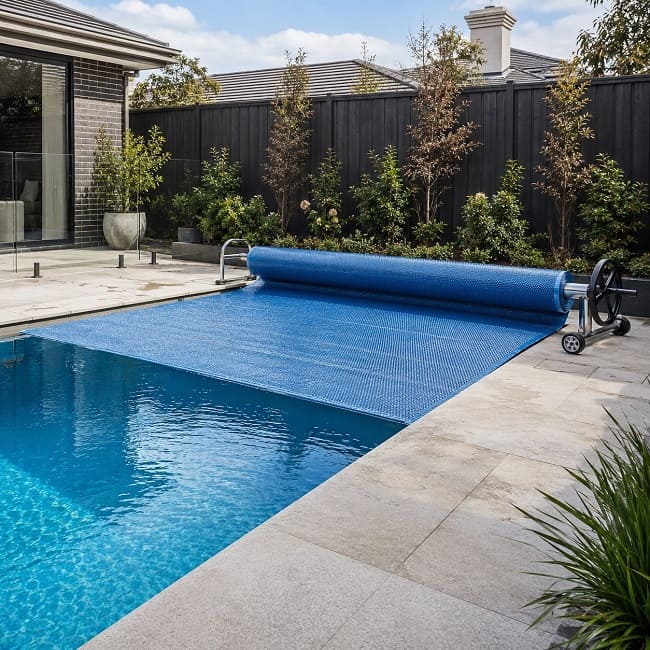
On a conventional bubble-style pool solar blanket, the bubble side faces down toward the water and the smooth side faces up.
Why the bubble side goes against the water
A bubble-style solar blanket is designed to float with the bubbles against the water and the smooth surface facing upward. Correct orientation helps the cover sit properly on the pool and keeps the shaped bubble layer in its intended position.
Direct contact with the water
The bubbles help the cover float directly on the water and follow the pool surface. They are intended to sit against the water rather than face upward into the sun and weather.
Correct fit across the pool
With the bubbles down, the blanket can lie naturally across the surface while the smooth side remains exposed above it. A correctly fitted cover should not be stretched tightly, ride high onto the coping or remain folded over itself.
Reduced evaporation
The main reduction in evaporation comes from covering the water surface. The blanket creates a physical barrier between the pool and the surrounding air, helping reduce both water loss and evaporative heat loss.
Less exposure of the bubble layer
Turning the cover upside down leaves the shaped bubble surface directly exposed to sunlight, weather and handling. Keeping the bubbles against the water leaves the smoother surface facing upward as intended.
If the cover has one smooth side and one side covered in small air bubbles, put the bubbles on the water.
How a solar blanket should sit on the pool
Orientation is only one part of correct installation. The blanket also needs to float freely, fit the pool reasonably closely and move onto and off the roller without repeated dragging or bunching.
The blanket should rest directly on the water. It does not need to be stretched tightly across the pool to work.
A cover can be accidentally reversed after cleaning, storage or removal from a roller. Before spreading it back over the pool, confirm that the bubbles are facing down.
Sections that repeatedly fold over, rub against coping or become trapped beside the roller can wear earlier than the rest of the cover.
Take the cover fully off the swimming area rather than leaving a large loose section floating beside swimmers or repeatedly folding it back onto itself.
Have a different type of cover? This guidance applies to conventional bubble-style solar blankets. Foam, multilayer and specialist covers can use different constructions, so follow the orientation and care instructions supplied by the manufacturer.
Why covering the water helps reduce evaporation
It is useful to separate the effect of the bubbles from the effect of covering the pool itself. A solar blanket reduces evaporation mainly because it places a physical barrier over the water surface.
Wind and dry air can increase evaporation from an uncovered pool. A blanket shields most of the water surface while it is in place.
Evaporation removes heat with the escaping water vapour. Limiting evaporation therefore helps the pool retain more of the heat already in the water.
A cover that leaves large areas of water exposed, constantly blows out of position or is too difficult to use may provide less practical benefit than a correctly fitted blanket that owners actually put back on the pool.
What causes premature pool blanket wear?
A blanket can be facing the correct way and still wear prematurely. Handling, storage, fit and roller alignment often determine which parts of the material fail first.
Repeated abrasion can damage the material, particularly around the edges and areas that contact rough pool surrounds.
If the blanket consistently winds towards one side of the reel, the same sections can be folded, stretched or dragged every time the cover is used.
Heat can build within rolled layers when the blanket is removed from the cooling effect of the pool water. Use the roller or storage protection recommended for the particular cover.
A badly positioned roller can make the cover drag over the pool edge, wind sideways or place unnecessary tension on attachment points.
If the blanket sags, drags or becomes difficult to roll: check the reel position, alignment, attachment points and cover fit before assuming that the blanket itself needs replacement.
Using a solar blanket in Melbourne conditions
Once the blanket is fitted correctly, how long it stays on should depend on water temperature, pool use and current conditions rather than one fixed schedule throughout the year.
The blanket is useful when the pool needs to retain warmth and reduce evaporation. If the water is already warmer than you want, the pool may benefit from spending more time uncovered.
Pool solar blanket FAQ
What should I do if my solar blanket is upside down?
Turn it over so the bubble side sits against the water and the smooth side faces upward. A short period upside down does not necessarily mean the blanket has been damaged, but it should be returned to its intended orientation.
Do pool cover bubbles go up or down?
Down. On a conventional bubble-style solar blanket, the bubbles sit against the water and the smooth surface faces upward.
Should a solar blanket stay on the pool all day?
Not automatically. Keep it on when reducing evaporation or retaining heat is useful, remove it completely before swimming, and leave it off for longer if the water is already warmer than you want.