
Why slippery pool walls in winter are a surface warning, not just a water test result

Winter pool care problem: clear water, slippery walls

If your pool walls feel slippery in winter but the water still looks clear, the issue is usually starting on the surface. The common causes are early biofilm, algae beginning in low-flow areas, reduced brushing, shorter pump runtime or a salt chlorinator setting that has been turned down too far for the actual conditions.

The early warning: slick surfaces before cloudy water

A slippery wall is one of the easiest winter pool algae signs to miss because it often appears before green water or visible cloudiness. From the house, the pool may look normal. A quick test strip may also look acceptable. The warning shows up when you run a hand across a wall, step, bench, ladder area or shaded corner and feel a slick layer instead of a clean pool finish.

That slick layer usually means growth or organic film is attached to the surface rather than floating through the water. In backyard pools, it is often a mix of early algae, bacteria, fine debris and biofilm. It can be thin enough to stay almost invisible, but established enough to make chlorine work harder at the wall.

Clear water does not always mean clean surfaces

Clear water tells you what the pool looks like from above. It does not prove that steps, walls, ladders, light niches and shaded corners are clean. A pool can look clear while biofilm is already developing in weak-circulation areas.

Winter makes this easier to miss. Many owners reduce pump time, lower salt chlorinator output, brush less, leave the cover on for longer and test less often. Each change can be reasonable on its own. Together, they can leave just enough time and low-flow surface area for a film to hold on.

What the slippery layer usually is: biofilm, early algae or both

Biofilm is a surface-attached layer of microorganisms and organic material. In a pool, it can form on walls, tile lines, steps, ladders, return fittings, skimmer throats, light niches and even inside pipework. Once it attaches, it is harder to deal with than loose dirt because the outside of the film protects what is underneath.

Early algae can feel similar. It does not always begin as bright green water. In winter it may first show as a dull, slippery or slightly greasy feel on the wall. That is why “pool feels slimy but clear” is a useful diagnostic clue: the pool is warning you before the whole body of water changes colour.

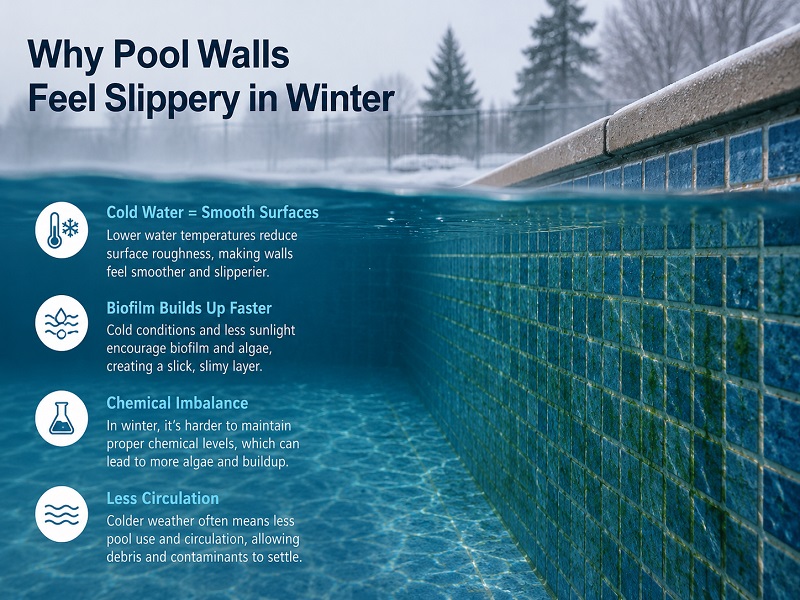
Pool wall and water surface showing why walls can feel slippery in winter
Slippery winter walls usually begin as a surface problem before the water turns dull or green.
Less brushing: the film is not physically broken away from the wall.
Dead spots: corners, steps and fittings receive weaker circulation.
Lower winter chlorine: less active sanitiser reaches attached growth.
Clear but slick: the issue is still local, which is the best time to act.
Key point: lower chlorine demand in winter does not mean the pool can run without sanitiser. It means the pool may consume chlorine more slowly. You still need a stable free chlorine level, good mixing and enough brushing to stop local surface growth.

Why winter makes slippery pool walls more likely

In winter, water is cooler, sunlight is weaker and swimmers are usually less frequent. The pool may lose chlorine more slowly than it does in summer, so it can look stable for weeks. That visual stability is exactly why small surface problems are easy to ignore.

The usual winter mistake

The problem is rarely one setting by itself. It is usually the combination of shorter runtime, lower chlorinator output, less brushing and fewer touch-checks.

Typical winter causes

  • Pump runtime becomes too short: water moves less, skimming weakens and low-flow areas become more noticeable.
  • Salt chlorinator output is reduced too far: winter demand is lower, but the pool still needs a measurable free chlorine residual.
  • Pool covers stay on longer: covers reduce debris and heat loss, but they also hide early surface changes.
  • Brushing stops: biofilm and early algae are surface problems, so brushing still matters when the water looks clear.
  • Leaves and fine organics sit longer: Melbourne wind, rain and garden debris can raise chlorine demand around corners, steps and floor areas.
  • Testing becomes occasional: water can drift slowly for weeks before the first obvious symptom appears.

When the walls feel wrong but the water still looks acceptable, the pool is still in an early stage. That is cheaper and easier to correct than waiting for a full green pool clean-up.

Dead spots: where slippery walls usually start

A dead spot is an area where water movement is weaker than the rest of the pool. Chlorine may be present in the pool as a whole, but it is not being delivered and mixed well at that surface. These areas are where slime, biofilm and early algae often appear first.

Area
Why it becomes slippery
What to check first
Steps and benches
Horizontal ledges hold fine debris and receive less sweeping flow.
Brush by hand, check if film returns and look at nearby return direction.
Behind ladders and rails
Metalwork interrupts flow and creates sheltered contact points.
Brush around brackets and inspect behind fittings where accessible.
Shaded wall sections
Lower light can hide early growth, and these areas are often checked less.
Touch-test the wall, brush it and compare it with a sunny wall.
Skimmer throat and waterline
Oils, pollen, dust and floating debris collect near the surface line.
Clean the waterline, empty baskets and check skimmer draw.
Return-side corners
Poor return aiming can leave one corner moving much less than the rest.
Watch surface movement while the pump runs and adjust eyeballs if needed.
AreaSteps and benches Why it becomes slipperyHorizontal ledges hold fine debris and receive less sweeping flow. What to check firstBrush by hand, check if film returns and look at nearby return direction.
AreaBehind ladders and rails Why it becomes slipperyMetalwork interrupts flow and creates sheltered contact points. What to check firstBrush around brackets and inspect behind fittings where accessible.
AreaShaded wall sections Why it becomes slipperyLower light can hide early growth, and these areas are often checked less. What to check firstTouch-test the wall, brush it and compare it with a sunny wall.
AreaSkimmer throat and waterline Why it becomes slipperyOils, pollen, dust and floating debris collect near the surface line. What to check firstClean the waterline, empty baskets and check skimmer draw.
AreaReturn-side corners Why it becomes slipperyPoor return aiming can leave one corner moving much less than the rest. What to check firstWatch surface movement while the pump runs and adjust eyeballs if needed.
Field check: brush the slippery section, run the pump and check the same spot again after a few days. If the film returns in the same place, treat it as a circulation or dead spot issue, not only a one-off chemistry problem.

How to tell slippery walls from normal cold-water feel

Cold water can make a finish feel different, but it should not make a pool wall feel slimy. A clean surface should still feel firm and consistent for that finish. If your hand glides over a slick layer, or brushing releases a faint cloud from the wall, the pool is showing an early maintenance warning.

Sign
Likely meaning
Next step
Wall feels slick but water is clear
Early biofilm or algae is attached to surfaces.
Brush all surfaces, test free chlorine and check circulation.
Slippery only near steps or corners
A dead spot or debris-holding area is likely.
Brush locally, clean baskets and check return flow.
Fine cloud appears while brushing
Surface film, dead algae, dust or fine organic material has lifted.
Brush, vacuum, filter longer and clean the filter if pressure rises.
Film returns quickly after brushing
There may be ongoing low chlorine, weak circulation or hidden debris.
Check FC/CYA relationship, pump runtime, filter condition and dead spots.
Water turns dull after winter neglect
The issue has moved from surface-only to water clarity.
Test full chemistry, clean mechanically and consider professional water testing.
SignWall feels slick but water is clear Likely meaningEarly biofilm or algae is attached to surfaces. Next stepBrush all surfaces, test free chlorine and check circulation.
SignSlippery only near steps or corners Likely meaningA dead spot or debris-holding area is likely. Next stepBrush locally, clean baskets and check return flow.
SignFine cloud appears while brushing Likely meaningSurface film, dead algae, dust or fine organic material has lifted. Next stepBrush, vacuum, filter longer and clean the filter if pressure rises.
SignFilm returns quickly after brushing Likely meaningThere may be ongoing low chlorine, weak circulation or hidden debris. Next stepCheck FC/CYA relationship, pump runtime, filter condition and dead spots.
SignWater turns dull after winter neglect Likely meaningThe issue has moved from surface-only to water clarity. Next stepTest full chemistry, clean mechanically and consider professional water testing.

Correct order: brush, circulate, test, then adjust

Do not treat slippery winter walls by randomly adding chemicals first. The surface layer has to be physically broken open, and the pool needs enough circulation to move sanitiser and released debris back to the filtration system. Chemical correction works better after the film has been brushed.

1. Brush walls, steps and benches. Start with the slick areas, then brush the rest of the pool so the same film is not left in another low-flow zone.
2. Empty skimmer and pump baskets. Winter leaves and fine debris can quietly raise chlorine demand.
3. Run the pump long enough to mix and filter. If short runtime caused the issue, a short run after brushing will not fix it.
4. Test free chlorine and pH. Free chlorine shows whether the pool has enough sanitiser. pH affects disinfection performance and comfort.
5. Check stabiliser if chlorine keeps underperforming. CYA changes how free chlorine should be interpreted in outdoor pools.
6. Vacuum or clean the filter if needed. Brushing moves material into the water. The filter still has to remove it.
7. Recheck the same wall after several days. If it becomes slick again, look at return direction, timer settings, filter condition and hidden debris.
Best winter habit

Do a quick touch-test during winter, not only a visual check. If the water looks clear but the wall feels slippery, act while the problem is still small.

Salt pools: why low winter output can still cause slippery walls

Salt pools often create this exact situation because the system feels automatic. In winter, many owners reduce chlorinator percentage or pump runtime. That can be sensible, but a salt chlorinator only produces chlorine while the pump is running and flow is passing through the cell. If runtime is too short, total chlorine production may be too low even though the system is switched on.

A salt chlorinator is also a production system, not an instant dose. If brushing releases a biofilm load, rain brings in debris, or the pool has stayed covered for weeks, the chlorinator may need help from longer circulation, cleaning and a properly measured chemical correction.

Do not diagnose by saying “it is a salt pool”

A salt pool can still have low free chlorine, poor mixing, a scaled cell, weak flow, dirty filters or local dead spots. Clear water does not prove that the walls are clean.

When slippery winter walls need professional attention

A light slippery feel can often be corrected with brushing, cleaning, circulation and proper water balance. If the same area becomes slimy again, the cause may be more than a missed brush. It may involve a circulation fault, blocked line, poor return direction, failing chlorinator output, dirty filter or an incorrect stabiliser-to-chlorine relationship.

Book a service check if
  • the walls feel slippery again within a few days of brushing;
  • free chlorine keeps dropping faster than expected for winter;
  • one corner, step area or wall section is always worse than the rest;
  • the pool is clear but has a persistent slick feel;
  • filter pressure, pump flow or chlorinator output looks inconsistent;
  • the water turns dull, cloudy or green after winter neglect.

The aim is not to over-treat the pool. The aim is to identify whether the slipperiness is coming from surface growth, poor circulation, low sanitiser availability, hidden debris or equipment performance. Once that is clear, winter maintenance is usually simpler than a spring recovery job.

FAQ: slippery pool walls in winter

Slippery pool walls in winter usually mean a thin surface film has started to develop. It may be early algae, biofilm, fine organic material or a mix of these. The water can still look clear because the problem begins on the wall before it becomes a full water clarity issue.

Yes. A pool can feel slimy but clear when growth is attached to walls, steps or dead spots rather than suspended through the water. This is an early warning sign and should be handled before the water turns dull, cloudy or green.

No. Lower winter chlorine demand means the pool may consume chlorine more slowly, not that sanitiser is unnecessary. You can often reduce production or dosing, but the pool still needs a stable free chlorine level, suitable pH and enough circulation.

Do not start by shocking blindly. First brush the surfaces, clean baskets, run the pump and test free chlorine, pH and stabiliser. If the results show low sanitiser or high demand, then use a measured correction.

Winter algae often starts in low-flow areas: steps, benches, shaded walls, behind ladders, corners, waterline areas and around fittings. These are the places to touch-test and brush even when the water looks fine.

Keep a simple winter routine: brush surfaces, remove debris, maintain circulation, test water, keep free chlorine in range for your pool and check known dead spots. If the same area becomes slippery again, inspect return direction, filter condition and chlorinator output.

Takeaway: slippery pool walls in winter are usually an early surface warning. The water can look clear while biofilm or algae begins on walls, steps or fittings. Brush first, restore circulation, test properly and investigate dead spots before the problem becomes a full green pool.

Reference guidance

This article follows established water-quality principles used in aquatic maintenance guidance: disinfection, pH control, circulation, filtration and regular removal of biofilm from wet surfaces.