

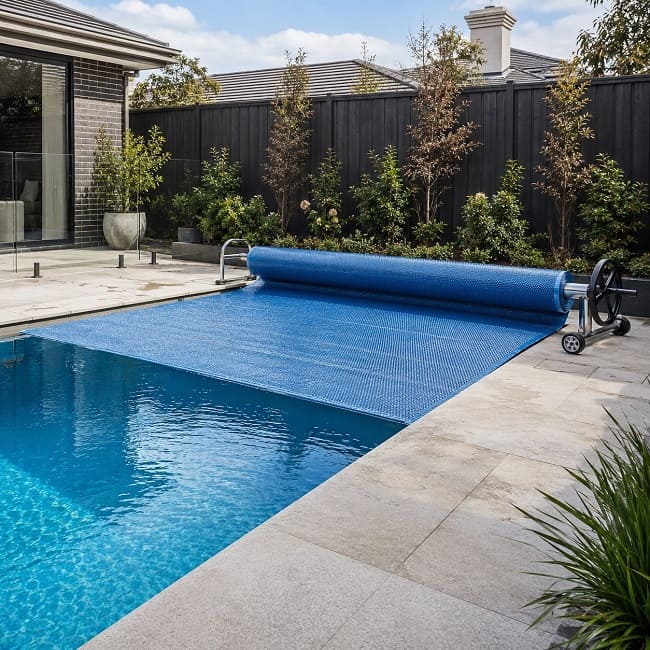
Servicing existing pool covers and manual rollers

Pool cover difficult to wind, tracking sideways or pulling unevenly?

Litra PoolCare services existing pool covers and manual blanket rollers across Melbourne's south-east, nearby Bayside suburbs and selected Mornington Peninsula areas. We check stiff winding, roller wobble, sideways tracking, broken straps, damaged clips, unstable wheel bases and wear around the cover edge.

A broken strap is often a symptom rather than the original fault. Roller position, strap tension, cover tracking and the condition of the attachment points are checked together so the same problem is less likely to return after a simple parts change.

Use this service when the current cover or roller is still usable but needs adjustment, tracking correction, straps, clips or mechanical attention. If the blanket or roller itself has reached the end of its usable life, see pool cover and roller replacement.

Roller movement: hubs, end fittings, tube movement, frame stability and winding resistance.
Tracking: roller position, strap spacing, tension and the direction in which the blanket winds.
Connections: straps, clips, attachment points, handles and load across the leading edge.
Blanket condition: local tears, chafe, brittle areas and damage around attachment points.

When this service is the right starting point

This service is for a cover and roller that are already installed and still usable, but no longer work as smoothly as they should. The visible fault is checked together with the parts that may be causing it.

Stiff or noisy winding

We check roller resistance, hubs, end fittings, frame movement and the load being placed on the tube.

Cover pulling to one side

We check roller position, strap spacing, tension and whether the tube or frame moves while the cover is wound.

Broken straps or clips

We inspect the failed attachment and check whether poor alignment or concentrated load contributed to the breakage.

Roller wobble or movement

We look at the frame, wheels, end supports and tube position while the roller is under normal load.

Local edge damage

We check whether the material around the damaged area is still strong enough to hold the existing attachment system.

Awkward day-to-day handling

We review roller position, poolside clearance and points where the cover catches, bunches or drags.

Common pool cover and roller faults we investigate

The roller has become hard to turn

Increased resistance may come from worn or contaminated hubs, corrosion, damaged end components, frame movement or excess load on the roller. Continuing to force the handle can put more stress on the tube, frame and blanket.

The cover winds towards one end

Uneven strap lengths, poor strap spacing, a roller that is not square to the pool or movement in the frame can make the blanket progressively track towards one side.

Straps or clips keep breaking

UV-aged webbing and plastic parts can fail with age. Repeated breakage can also point to excessive tension, a sharp contact point or uneven pull across the front of the blanket.

The roller wobbles during use

Movement may come from the wheel base, frame, end supports or tube connection. A roller that shifts under load can make an otherwise usable blanket wind unevenly.

The leading edge is beginning to tear

If one or two attachment points are carrying too much load, the material around them can begin to split. That load should be corrected before another strap or clip is fitted.

The cover rubs against coping or paving

Steps, curves, corners and roller position affect the way the blanket leaves the water. Repeated contact with the same hard edge can produce local abrasion even when the roller itself turns freely.

Work that may be suitable for a serviceable cover and roller

What can be done depends on the construction, age and condition of the installed equipment. Parts availability also varies between manufacturers and older roller models, so compatible components are confirmed before fitting.

Roller hardware and alignment

  • inspect end fittings and hub movement;
  • check whether the tube remains straight and stable while winding;
  • adjust roller position where the installed design allows it;
  • inspect wheel bases and frame stability;
  • identify contact points adding unnecessary resistance.

Straps, clips and attachment points

  • replace compatible straps or clips where required;
  • correct obvious differences in strap spacing or tension;
  • check whether the cover edge can still hold each attachment securely;
  • reduce poor pull angles where adjustment is possible;
  • inspect handles and the points normally used to move the blanket.

Local cover-edge problems

Some localised attachment or edge problems can be assessed, but not every solar blanket material is suitable for a durable repair.

  • inspect wear around straps and clips;
  • identify abrasion against coping, paving or other hard edges;
  • check whether the surrounding material remains flexible and strong;
  • refer brittle, extensively cracked or delaminating blankets to replacement.

Cover path and handling

  • check how the blanket leaves the water and approaches the roller;
  • look for corners or steps causing bunching or uneven loading;
  • check clearance around the parked roller;
  • test winding again after agreed adjustments have been completed.

How we trace the cause of a winding problem

The place where damage appears is not always where the problem starts. A torn strap, for example, may be the result of poor roller alignment rather than a fault with the strap itself.

  1. Poolside layout We look at roller position, paving, clearance, pool shape and the route used when deploying and retrieving the blanket.
  2. Roller movement The tube, hubs, end components, frame and wheels are checked for stiffness, play or movement under load.
  3. Straps and load distribution We compare strap spacing, length, tension and attachment condition across the leading edge.
  4. Wear pattern Tears, rubbing and damaged attachment points are compared with the direction in which the blanket tracks during winding.
  5. Agreed service work Compatible parts are fitted and the roller is adjusted where required, provided the remaining equipment is in suitable condition.
  6. Operating test The blanket is wound through its normal path again to check tracking, roller stability and handling.

Conditions that can accelerate cover and roller wear

Sun and UV exposure

Pool blankets, webbing and plastic fittings spend long periods outdoors. As these materials age, attachment points that once handled normal tension can become more prone to cracking and tearing.

Wind exposure

Open pool areas can place extra load on a loose or partially deployed blanket. A mobile roller may also move if it is parked on an exposed or uneven section of paving.

Leaves, grit and debris

Gum leaves, sand and garden debris can add weight to a wet blanket, increase drag and create abrasive contact around the cover edge or roller components.

Uneven pool surrounds

A mobile roller sitting on sloping or irregular paving can shift while it is being used. That movement changes the angle at which the straps pull the blanket.

How to reduce repeat winding problems

Clear the route before winding

Move hoses, toys and other obstacles away from the blanket. A snag can suddenly place most of the load on one strap or one section of the leading edge.

Do not force a stiff handle

If resistance increases noticeably, stop using extra leverage. Continued force can damage a tube, frame or attachment point that may initially have needed only adjustment or servicing.

Act when tracking changes

If the blanket begins winding progressively towards one end, have the setup checked before the edge starts bunching or the outer straps become heavily loaded.

Remove heavy debris first

Wet leaves and accumulated debris increase the weight being wound onto the tube. Removing them first reduces load on the straps, roller and leading edge.

Photos that help us assess the problem

A close-up of the failed part is useful, but wider photos are also important because they show the relationship between the roller, straps, blanket and pool edge.

Whole roller

Show the tube, frame, wheels and where the roller normally sits beside the pool.

Full pool and cover path

Include the pool shape, steps, corners and the route the blanket takes towards the roller.

All straps and clips

Show their spacing and condition, not only the strap or clip that has already failed.

Damaged area

Send close photos of tears, abrasion, cracked material or damaged attachment points.

Both roller ends

Include the handle, hubs and supports, especially if noise or resistance seems to come from one end.

Suburb and symptom

Tell us your suburb and what happens when you try to wind or deploy the blanket.

Cover or roller already at the end of its usable life?

A blanket that is extensively brittle, cracked or delaminating is normally a replacement job rather than a strap or edge repair. The same applies where the roller tube or frame is badly bent, unstable or no longer practical to use. Replacement sizing and installation are covered on the separate service page.

Pool cover & roller replacement

Service limits

Motorised cover systems

Litra PoolCare can inspect visible tracking, cover movement and mechanical symptoms. Motors, power supplies, hard-wired controllers and electrical circuit faults may require an appropriately licensed electrical contractor or the manufacturer's authorised service provider.

Safety barriers

Servicing a blanket or roller does not certify swimming-pool barrier compliance. A general pool cover should not be relied on as a substitute for the safety barrier required for the property unless the installed system has been specifically approved for that purpose.

Pool cover and roller service FAQ

Can you service my roller without replacing the pool cover?

Yes, where the blanket itself remains usable and the fault is in the roller, straps, clips, alignment or winding setup. The cover condition is checked first because badly brittle or weakened material may not tolerate new attachment points or continued winding.

Why does my pool cover keep rolling to one side?

Common causes include uneven strap spacing or tension, a roller that is not square to the pool, movement in the frame or tube, and uneven loading across the leading edge. Correcting only one strap may not stop the problem if roller position is the real cause.

Can broken pool cover straps and clips be replaced?

Often yes, provided compatible parts are available and the material around the attachment points is still strong. If the blanket is brittle, cracking or splitting across several areas, replacing straps alone is unlikely to provide a durable result.

How do I know when servicing is no longer worthwhile?

Widespread blanket deterioration, extensive cracking or delamination, a badly bent roller tube, an unstable frame or a setup that remains impractical to use can make replacement the better option. Replacement work is covered on the dedicated pool cover and roller replacement page.

Need help with an existing pool cover or roller?

Send photos of the roller, straps, blanket edge and poolside layout together with your suburb and a short description of the fault. Litra PoolCare can determine whether the problem is likely to need adjustment, compatible service parts or an on-site inspection.

Service Area Map: South-East Melbourne, Nearby Bayside Suburbs & Selected Peninsula Areas

Tap a suburb chip to focus the map. We mainly service Carrum Downs, Frankston, Seaford, Chelsea, Patterson Lakes and nearby south-east suburbs, with selected Mornington Peninsula coverage.

Map shows the main service radius around Carrum Downs. Final visit availability still depends on suburb, access, and current workload.
Map could not load. Service areas include Carrum Downs, Frankston, Seaford, Chelsea, Patterson Lakes, Langwarrin, Skye, Edithvale, Aspendale, Mordialloc and nearby south-east suburbs.
Cleaning Maintenance Skimmer Filtration Chlorine Algae Pump Backwash Vacuum pH Level Sanitizer Brush Debris Water Test
Call Now Button