

Need the property reviewed before detailed equipment work is quoted?
Litra PoolCare can visit the property to review access, the available work area and physical site constraints before detailed pool equipment work is quoted. This service is useful when photographs do not show enough of the property to judge how technicians, equipment or other trades will reach and work around the pool equipment area.
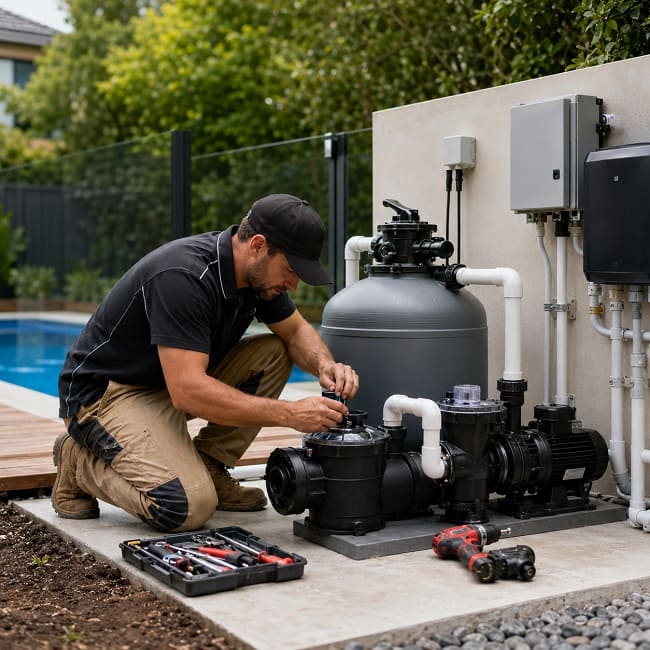
When an in-person site review is useful
Many enquiries can be reviewed from clear photographs. An on-site visit becomes more useful when the property itself creates uncertainty that cannot be judged reliably from images.
Access cannot be judged from photos
A close-up of the pool equipment does not show the route through the property. Narrow side passages, gates, stairs, retaining walls and changes in ground level may affect how future work can be carried out.
The equipment area is far from vehicle access
Long carrying distances, restricted parking or difficult paths through the property can matter when technicians need to bring tools, parts or larger equipment to the pool area.
Several trades may need to reach the same area
Some projects may later involve pool technicians together with electrical, gas, refrigeration or building specialists. A physical review can show whether those trades can reasonably reach and work around the site.
Fixed structures limit the usable work zone
Walls, fences, sheds, landscaping, paving edges or other permanent structures may leave less working room than photographs suggest. Seeing the complete area can prevent those constraints being missed before quoting.
If the equipment is not working correctly, book a fault inspection
A pre-quote property visit does not diagnose operating faults. If the pump is losing prime, water flow is weak, filter pressure is abnormal, equipment is noisy, a chlorinator or heater shows an error, or visible equipment is leaking, the problem should be investigated as an equipment fault.
Use the dedicated inspection and repair service for fault finding and operating symptoms.
View equipment inspection & repairWhat is reviewed at the property
The visit records physical conditions that may affect access and the ability to carry out future work safely and practically. It does not replace equipment selection, model compatibility checks or detailed installation planning.
Vehicle-to-equipment access
The route from practical vehicle access to the pool equipment area can be checked for distance, steps, corners, narrow sections and other restrictions.
Gates and side passages
Gate openings, narrow paths and side access are considered where they may affect the movement of technicians, tools or equipment through the property.
Stairs and changes in level
Steps, sloping ground, retaining walls and different surface levels are noted where they may make access more difficult than a photograph indicates.
Available work zone
The general space around the equipment location is viewed to establish whether technicians can reasonably reach the area and work without the site being obstructed by permanent structures.
Nearby fixed structures
Fences, walls, sheds, landscaping and other permanent features are noted where they may restrict access or the usable work area.
Access for specialist trades
Where later work may require electrical, gas, refrigeration or another specialist trade, the site can be viewed to identify obvious access limitations before those trades are organised.
What this visit does not replace
The site review is deliberately limited to the physical property and access conditions. Detailed technical decisions belong to the relevant equipment service.
What happens during the site visit
The visit concentrates on the parts of the property that may affect a later equipment quote or specialist appointment.
Review the access route
The route from the street or practical parking position to the equipment area is viewed in person.
View the work area
The space around the equipment location and nearby permanent structures is checked for obvious physical restrictions.
Record relevant constraints
Conditions such as narrow access, stairs, long carrying distances or restricted working space can be identified before detailed work is quoted.
Confirm what needs further assessment
Technical questions about equipment selection, compatibility, faults or installation can then be directed to the relevant service rather than assumed during the property visit.
What should be clearer after the visit
The aim is to remove uncertainty about the physical property before a more detailed equipment quote or specialist visit is arranged.
If you already know what the pool needs
A general property visit may not be necessary when the required service is already clear.
What to send before requesting a visit
Photos may show that the site can be assessed without an additional property visit, so start with the widest useful view rather than close-ups alone.
Photograph the equipment area and the access route
Include one wide photograph of the pool equipment area and additional views showing how a technician would reach it from the property entrance or practical parking position.
- show gates and side passages;
- include stairs or changes in level;
- show nearby walls, fences or fixed structures;
- include the street-to-equipment route where access is unusual.
Send the suburb and postcode together with the photos.
Explain why photos are not enoughMention narrow access, stairs, distance from parking, restricted working room or another site condition that you want checked in person.
Keep photographs externalDo not remove electrical covers, controller panels or protective guards.
Access for licensed trades
A property review can identify access constraints, but restricted electrical, gas and specialist work must still be completed by appropriately qualified providers.
Electrical work
Electrical installation work must be arranged through a Registered Electrical Contractor and completed by an appropriately licensed electrical worker. Electrical installation work in Victoria requires a Certificate of Electrical Safety.
Gas and specialist work
Gas installation, connection or alteration requires a licensed gasfitter. Refrigeration, structural, drainage or other restricted work may also require the appropriate specialist.
Property visits in south-east Melbourne
Send the location and access details first
Regular service routes are concentrated around Carrum Downs, Frankston, Seaford, Skye, Langwarrin, Patterson Lakes, Chelsea, Edithvale, Aspendale and Mordialloc. Other locations can be confirmed individually according to the property, job scope and current route availability.
For site visits, include any access issue that may affect the appointment, such as restricted parking, a long walk from the street, narrow gates or stairs.
Pool equipment site visit FAQ
When is an on-site visit better than sending photos?
A visit is more useful when photographs do not show the access route, stairs, gates, changes in level, working space or nearby structures clearly enough to understand the physical conditions at the property.
Does the visit include equipment fault diagnosis?
No. If the pool has weak flow, a leak, abnormal filter pressure, loss of prime, unusual equipment noise or an error message, book pool equipment inspection and repair.
Will you select the new equipment during this visit?
Not as part of the general property review. Specific equipment sizing, model compatibility and manufacturer requirements are assessed when the actual equipment project is being planned.
Is this an installation quote?
No. The visit records physical access and site constraints that may need to be considered before detailed work is quoted. If the installation project is already defined, use the pool equipment installation service.
What if I already know that equipment needs replacing?
If replacement is already the confirmed requirement, use the pool equipment replacement service. A separate property visit is mainly useful when unusual physical access needs to be reviewed first.
Can I send access photos before deciding whether a visit is necessary?
Yes. Send one wide equipment-area photo together with views of gates, side access, stairs and the route from practical parking to the pool equipment area. In some cases the physical conditions may be clear enough from those images.
Need the property checked before a detailed quote?
Send wide photos of the equipment area and access route, your suburb and a short description of the physical site concern. If the access or work area needs to be seen in person, Litra PoolCare can arrange a property visit.