


Slippery pool walls can be an early sign of a surface biofilm, algae or weak circulation, but the feel of the wall is not enough to identify the cause. Check free chlorine, pH, stabiliser in an outdoor pool and water movement before deciding whether the pool needs treatment.
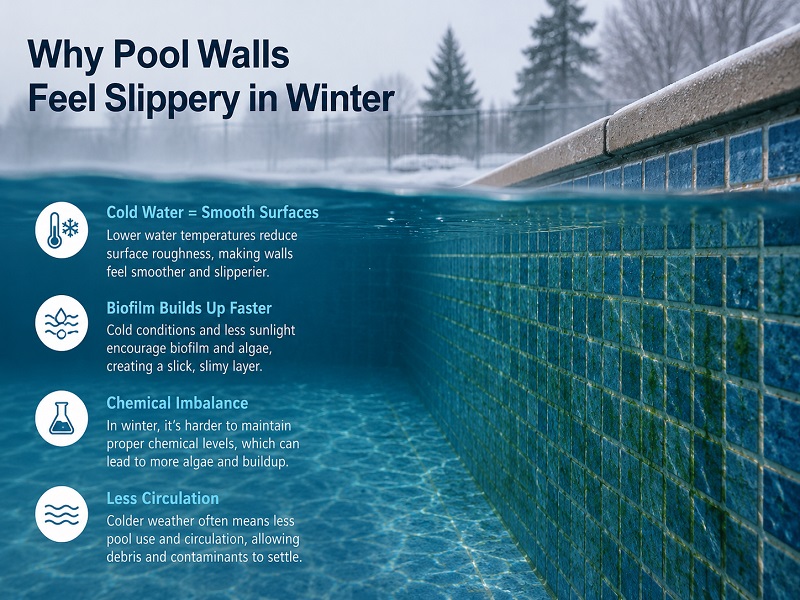
Start With Four Checks
Clear water does not rule out a developing surface problem. Start with the affected area, then compare what you find with the water-test results and circulation.
What Slippery Pool Walls Usually Mean
A slick surface usually means something is remaining attached to the pool finish. The cause may be an early microbial film, algae, fine organic debris or a local circulation problem that allows material to build up faster than it is removed.
Biofilm can appear before the water changes colour
Biofilm is a thin layer of microorganisms and organic material attached to a wet surface. In a pool it may feel slick before there is enough visible growth to affect water clarity. Brushing can release fine material, but what comes off the wall should be considered together with water-test results.
Some areas receive less circulation
Steps, corners, benches, recessed fittings and areas behind ladders may receive less sweeping flow than open sections of the pool. If the same location repeatedly becomes slippery, check return direction, pump flow, filter condition and debris around that area.
Equipment operation does not prove chlorine is adequate
Pump runtime and chlorinator percentage do not tell you how much free chlorine remains in the pool. Test the water. If the residual is lower than the pool requires, attached growth can develop even when the equipment appears to be operating normally.
Check the water and circulation before treating the problem as algae. This helps distinguish a local maintenance issue from a wider water-quality problem.
How to Diagnose a Slippery Pool Wall
Look at several clues together: where the problem occurs, what comes off during brushing, chlorine readings, water clarity and circulation around the affected area.
| Symptom | Likely cause | First test | Action |
|---|---|---|---|
| Wall feels slick but the water is clear | Early surface film, developing algae or a section missed during routine brushing | Test free chlorine and pH, then brush a small section and inspect what releases | Brush the pool, remove debris, run circulation and reassess the surface with fresh water-test results |
| One step, corner or wall section keeps becoming slippery | Weak local circulation, trapped debris or incomplete brushing | Watch return flow and compare the affected area with nearby clean surfaces | Clean the area, check baskets and filter flow, inspect return direction and recheck after normal circulation |
| The slippery layer returns soon after brushing | Insufficient chlorine residual, continuing organic load or an unresolved circulation problem | Retest free chlorine and check how quickly it changes between tests | Correct the water or circulation problem that is allowing the surface layer to return |
| Green, yellow or dark material is visible on the surface | Attached algae or another coloured surface deposit | Check colour, location, attachment and how the material responds to brushing | Compare the signs with known algae types before choosing treatment |
| Walls are slippery and the water is becoming dull or cloudy | Developing algae, high organic load or weak filtration and circulation | Check free chlorine, pH, filter pressure, return flow and visible debris | Brush and clean promptly, restore effective filtration and investigate the chlorine loss |
| The problem started after reducing pump runtime or chlorinator output | Daily chlorine production or circulation has been reduced below the pool's actual requirement | Measure free chlorine and confirm actual pump and chlorinator operation | Adjust runtime or output from test results and pool condition, not from the season alone |
What to Check Before Adding Chemicals
Start with water testing and circulation checks. Adding chlorine without knowing the current readings can make it harder to understand why the problem developed.
Test free chlorine
Use a measured result, not the chlorinator percentage or timer setting. If chlorine is dropping faster than expected, look for organic load, algae, equipment problems or an operating schedule that is no longer adequate.
Check pH
Test pH at the same time and compare it with the target range used for that pool and sanitising system. If readings are unstable, avoid making several large adjustments at once.
Include CYA for an outdoor pool
Cyanuric acid affects how free chlorine should be interpreted. A chlorine result on its own does not give the full picture when stabiliser is present.
Watch the return flow
Run the pump and compare water movement around the pool. Pay particular attention to steps, corners, benches and recessed sections that repeatedly develop a slick surface.
Check baskets and filter behaviour
Empty blocked baskets and compare filter pressure with the system's clean baseline. Weak returns, unusual pressure or poor pump priming can reduce circulation through the pool.
Brush the affected area
Use a brush suitable for the pool finish. Note whether fine material, colour or a visible cloud comes off the surface and whether the problem returns after the pool has circulated.
Litra PoolCare provides pool water testing and balancing when chlorine behaviour is difficult to explain or several water-balance factors need to be checked together.
Where Circulation Dead Spots Develop
A dead spot is an area with weaker effective water movement. It does not necessarily mean the water is completely still, only that circulation there is less effective than across the main body of the pool.
Steps and benches
Horizontal surfaces hold fine debris and often sit outside the strongest return-current path. Brush the tread, risers and edges and check whether debris settles there again.
Corners and swim-outs
Corners and recessed areas can receive weaker sweeping flow. A problem that repeatedly returns to the same spot is a good reason to inspect local circulation.
Behind ladders and fittings
Rails, brackets and other fittings interrupt water movement and create sheltered areas that are easy to miss during brushing.
Areas outside the main return path
Return fittings may create strong circulation in one part of the pool while leaving another section with weaker movement. Return direction should suit the shape and plumbing of the pool.
Why the Problem Can Appear in Winter
Cooler water and weaker sunlight often reduce chlorine demand. That lower demand is not the cause of slippery walls. Problems develop when pump runtime, chlorinator output, brushing or testing are reduced further than the pool's actual winter requirements allow.
Chlorine demand may fall.
Pump hours or chlorinator output may be cut.
Chlorine residual or circulation becomes inadequate.
Low-flow areas can begin to feel slick.
Lower demand still requires a measurable residual
A pool may use less chlorine in cooler weather, but chlorine production still has to match the remaining demand. Reduce chlorinator output gradually and confirm the result by testing the water.
Shorter filtration time means less circulation
Cutting pump runtime reduces the time available for skimming, filtration and mixing. Local low-flow areas can become more noticeable when the circulation window is shortened.
Clean-looking water can hide a surface problem
Walls and steps may be brushed less often when the pool is not being used regularly. An attached layer can develop while the water still looks clear from above.
Output and runtime both affect daily production
A salt chlorinator generates chlorine while the circulation system is operating under the required flow conditions. Reducing both the output setting and pump runtime can cut total daily production more than expected.
Pool volume, sunlight, debris, cover use, water temperature, circulation and chlorinator performance all affect the operating schedule. Adjust settings from measured results and the condition of the pool.
How to Prevent Slippery Pool Walls
Prevention is mainly about keeping surfaces clean, maintaining enough circulation and catching changes in water chemistry before an attached layer becomes established.
Brush walls and steps regularly
Brushing removes material that filtration cannot collect while it remains attached to the pool surface. Include steps, benches, corners and other areas with weaker water movement.
See Brushing Your Pool Walls and Steps for a more detailed maintenance routine.
Test even when the water looks clear
Water clarity is not a substitute for testing. Check chlorine and pH regularly and include CYA when assessing an outdoor stabilised pool.
Remove organic debris
Empty skimmer and pump baskets, remove leaves and clean settled material from steps and corners. Organic debris adds chlorine demand and can collect where circulation is weakest.
Watch repeat problem areas
If one wall or step has become slippery before, check it during routine maintenance. A problem that keeps returning to the same location often points to a local flow or cleaning issue.
The walls remain clean between brushing cycles, chlorine stays within the pool's intended operating range, circulation remains consistent and the same local areas do not repeatedly develop a slick coating.
What to Do If Algae Is Already Growing
Visible growth, cloudy water, rapid recurrence after brushing or unusual chlorine loss suggests that the pool may need more than routine prevention.
Identify the type of growth first
Green, yellow and dark patches can behave differently, and some stains or deposits can be mistaken for algae. Check colour, location, attachment and how the material responds when brushed.
Use Black Algae vs Mustard Algae vs Green Algae to compare the main signs before treatment.
Brush and remove debris
Physically disturb attached growth with equipment suitable for the pool finish. Remove leaves and settled debris and make sure the circulation and filtration system is operating properly.
Use measured chlorine and CYA results
If testing and inspection confirm algae, base the chlorine treatment on the measured water condition and the CYA level in an outdoor stabilised pool. Follow the selected treatment method and product instructions instead of choosing a dose from the slippery feel alone.
Recheck the pool after treatment
The surface should stop becoming slippery, water clarity should recover and chlorine behaviour should become predictable again. If the same symptoms return quickly, the underlying problem has not been resolved.
If the water is green, significantly cloudy or algae returns quickly after cleaning, see green pool recovery for a more complete recovery process.
When to Investigate Further
A light one-off film may disappear after brushing and correcting the water conditions. A problem that keeps returning deserves a closer look.
The same area becomes slippery again
Check return flow, trapped debris and how thoroughly the area is being brushed. Repeated problems in one location are often linked to local conditions.
Free chlorine keeps falling unexpectedly
Check CYA, organic load, chlorinator operation and the overall condition of the pool. Repeated chlorine loss is more useful diagnostically than one isolated reading.
Filter pressure or return flow has changed
Weak returns, unusual filter pressure, poor pump priming or intermittent chlorinator flow can indicate an equipment or circulation issue.
Water clarity is getting worse
Dull, cloudy or green water together with slippery walls suggests the issue is progressing beyond a small local surface film and should be addressed promptly.
Related Pool Care Guides and Services
Slippery Pool Wall FAQ
Do slippery pool walls always mean algae?
No. Algae is one possible cause, but organic film, accumulated debris and weak circulation can produce a similar feel. Check the water and the affected area before choosing treatment.
Can the pool stay clear while algae starts growing on the walls?
Yes. A local surface problem can develop before enough material enters the water to noticeably affect clarity. This is why walls, steps and known low-flow areas should be checked during routine maintenance.
Should I shock the pool as soon as the walls feel slippery?
No treatment decision should be based on touch alone. Brush the affected area, test free chlorine and pH, check CYA in an outdoor stabilised pool and inspect circulation. If those checks confirm active algae, treat it using the measured water condition and the appropriate treatment method.