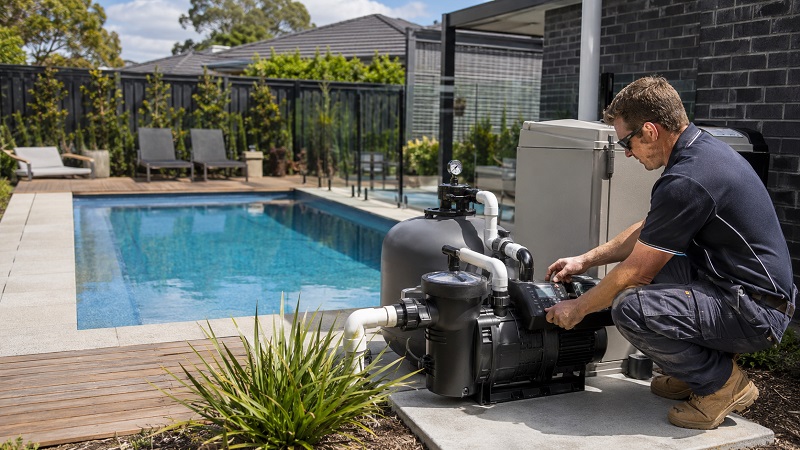
A variable-speed pool pump only saves money when its speeds and run times match the real pool system. Daily filtration can often run at a lower speed, but heaters, solar heating, salt chlorinators, suction cleaners, vacuuming and backwash cycles may need higher flow at specific times. Litra PoolCare sets practical pump modes, checks flow-critical equipment and explains which settings should stay fixed and which settings can be adjusted for storms, heatwaves, heavy use and seasonal changes.
Variable-speed setup is useful when the pump has been installed but the pool still needs a working schedule. The aim is not to choose the lowest possible RPM. The aim is to set the lowest practical speed for each job without losing skimming, heating flow, salt chlorination, cleaning performance or water clarity.
The pump needs named modes and run times matched to the filter, chlorinator, heater, valves and pool use.
Noise can come from RPM choice, vibration, air, mounting, unions, pipe resonance or worn mechanical parts.
The cell may stop producing chlorine if the selected pump speed does not satisfy the flow switch or cell requirements.
Heating equipment often needs a dedicated higher-flow mode so it does not fault, short-cycle or heat inconsistently.
Low speed is only useful if the pool still pulls floating debris into the skimmer and keeps water movement even.
We reduce wasted speed and runtime while protecting daily circulation, sanitation and equipment operation.
Timer rules may need resetting after pump, chlorinator, heater, solar, valve or controller changes.
Pump speed is not a chemical treatment by itself, but it affects how well the pool mixes, filters, skims and supports chlorine production in salt pools. When pump runtime is reduced too far, free chlorine can drift down, debris can stay longer in the pool and water can become dull even if the equipment is new.
The figures below are cautious operating context for private outdoor pools, not a universal dosing instruction. Product labels, pool volume, surface type, bather load, water temperature, local rules and equipment manufacturer instructions must still be followed. For public, commercial, body corporate or learn-to-swim pools, the relevant Victorian aquatic facility requirements and site water quality risk management plan take priority.
| Metric | What this metric means | How to read it during pump setup |
|---|---|---|
| Free chlorine (FC) | The active sanitation reading. Outdoor stabilised pools often need a higher practical FC target than a simple standalone number suggests. | If FC drifts down after reducing runtime, the salt output, pump schedule, bather load, sunlight and debris load need review before cutting hours further. |
| Cyanuric acid (CYA) | Stabiliser that reduces UV chlorine loss in outdoor pools. Too much CYA can reduce chlorine effectiveness and make FC harder to interpret. | If CYA is too low, sunlight can consume chlorine quickly. If it is too high, increasing pump runtime alone will not solve the underlying chemistry problem. |
| pH | Affects swimmer comfort, chlorine performance, scale tendency and equipment protection. Many pool references place practical pool pH around the low-to-mid 7 range. | If pH is drifting, check alkalinity, aeration, salt cell operation and dosing habits. Pump setup should not hide a recurring water balance issue. |
Variable-speed pump setup must match the pool type. A private outdoor backyard pool, a body corporate pool, a public aquatic facility, a spa and an indoor pool can have different risk levels, testing duties, heating load, bather load and chemical limits.
Most setup work is about filtration, skimming, salt production, heater flow and practical owner handover. Water testing is still needed after major runtime changes.
Schedules, testing and records must follow the relevant aquatic facility rules and site water quality plan. A residential shortcut should not be used as the operating standard.
Higher temperature and smaller water volume change risk. Do not apply outdoor pool CYA and runtime logic to a spa without checking the specific requirements.
Sunlight and stabiliser behaviour differ from outdoor pools. Ventilation, chloramine control, heating and turnover can matter more than UV protection.
A good setup uses several purposeful modes instead of one fixed speed for every task. The lowest daily speed is only useful if it still skims, circulates, supports chlorine production and keeps the pool clear between visits. Higher speeds are reserved for jobs that genuinely need more flow.
| Pump mode | What it does | How to read the setting |
|---|---|---|
| Prime | Starts the pump fast enough to purge air and establish stable flow after startup. | If priming takes too long or fails, check suction leaks, basket seal, water level, valves and lift before simply raising speed. |
| Daily filtration | Runs the pool at the lowest practical speed for everyday circulation and filtration. | If water dulls, debris sits on the surface or FC falls in a salt pool, the daily mode may be too short, too slow or poorly timed. |
| Skimming burst | Adds short higher-flow periods to pull surface debris into the skimmer. | Useful in Melbourne after wind, gum leaves, pollen, heatwaves and weekend use when low RPM alone does not clear the surface. |
| Heating or solar | Provides the minimum reliable flow needed for heater, heat pump or solar operation. | If equipment shows low-flow faults, the mode must be tested with valves and filter condition as they actually operate. |
| Cleaning or vacuum | Gives enough suction and movement for manual vacuuming or suction-side cleaning. | This is not usually the everyday mode. It should be used for cleaning periods, storm recovery and visible debris loads. |
| Backwash or waste | Runs at a purposeful speed for backwash, rinse, waste or cleanup tasks where the filter valve setting requires stronger flow. | These are short service modes. They should not be confused with normal daily filtration. |
Variable-speed pumps are efficient because many filtration tasks can be done at lower speed. Australian energy guidance also notes that multi-speed and variable-speed pumps can run slowly for filtering and speed up when more power is needed. The setup still has to protect water clarity, heater flow, salt chlorinator operation and equipment life.
We check pressure trend, basket condition, priming behaviour and obvious restriction before choosing final speeds.
We reduce everyday speed only to the point where skimming, circulation and salt production remain reliable.
Heater, heat pump, solar and chlorinator modes are tested at the settings they will actually use.
Melbourne summer, heatwaves, storms, heavy bather load and cooler months need different runtime decisions.
Running cost = pump kW × hours × electricity tariff. Estimated saving = old daily kWh − new daily kWh, multiplied by the tariff. Where the pump displays watts or amps, those readings help compare modes. If the pump does not show reliable draw data, the estimate remains approximate.
Melbourne pools can move from cool, low-demand conditions to hot weekends, wind, rain and heavy debris quickly. A fixed schedule that worked in winter may be too weak in summer, and a high-speed summer schedule may waste money in cooler months.
Use this table as a diagnostic guide, not as a repair quote. One symptom can come from pump programming, plumbing, filter condition, water level, valves, chemistry or worn equipment. The first check is to identify whether the problem is a setting issue or a fault that needs repair.
| Symptom | Likely checks | First correction path |
|---|---|---|
| Salt chlorinator low-flow warning | Pump speed, dirty filter, closed valve, air in basket, cell condition, flow switch position. | Verify filter and valve condition first, then set a chlorination mode that keeps the cell satisfied. |
| Heater or solar low-flow fault | Heating bypass, filter pressure, pump speed, valve position, priming stability, equipment minimum flow. | Create a dedicated heating mode and test it with the heating circuit active. |
| Poor skimming at low RPM | Water level, weir door, return direction, skimmer basket, daily speed, debris load. | Add a practical skimming speed or short skimming bursts rather than raising the whole day unnecessarily. |
| Noisy pump at one speed | RPM resonance, base vibration, unions, pipe support, bearings, air, cavitation signs. | Test nearby speeds, check mounting and pipework, then isolate whether mechanical repair is needed. |
| Cloudy water after schedule reduction | FC trend, CYA, pH, filter condition, salt output, runtime, storm debris, bather load. | Restore water testing and filtration baseline before making further runtime cuts. |
Litra PoolCare services Melbourne domestic pools, managed properties and equipment systems where pump speed affects water clarity, heating, salt chlorination and day-to-day running cost. During setup, we do not treat the pump as a standalone appliance. We check how the pump interacts with filtration, valves, water level, salt output, heater or solar flow and recent pool conditions.
Book testing if FC keeps falling, pH keeps drifting, the pool clouds after runtime changes, CYA is unknown or storm overflow has changed the water.
Call for inspection if the pump loses prime, runs loud, shows air in the basket, trips, leaks, faults under heating load or cannot satisfy the chlorinator flow switch.
These references support the broad operating principles used on this page. They do not replace product labels, local rules, site-specific aquatic facility plans or on-site water testing.
Often, but not automatically. Savings depend on the speed map, runtime, electricity tariff, filter condition and whether the pool still has enough flow for skimming, heating, salt chlorination and water clarity. Running too fast wastes power; running too slow can create water and equipment problems.
The pump may be running below the chlorinator’s practical flow requirement, or the issue may be a dirty filter, valve position, air leak, blocked basket, scaled cell or faulty flow switch. We check the physical causes before changing speed permanently.
Heating equipment usually needs stronger and more stable flow than low-speed daily filtration. A dedicated heating or solar mode helps prevent low-flow faults and short-cycling, provided valves, filter and plumbing are in suitable condition.
Not always. Very low RPM may reduce energy use per hour but can fail to skim properly, underfeed a salt chlorinator, reduce heater flow or leave debris in the pool. The correct setting is the lowest practical speed that still does the job.
Sometimes. Cloudy water can be caused by poor circulation or short runtime, but it can also come from low FC, high pH, stabiliser imbalance, filter overload, algae pressure or fine debris. If water remains unstable, professional water testing is the next step.
Yes, where the equipment supports it. We align pump schedules with timers, automation, heating calls and chlorinator operation so the system changes mode when expected.
Need the pump set up properly for daily use, heating, solar, salt chlorination and cleaning? Litra PoolCare sets practical speeds, checks flow-critical equipment and explains how to use the schedule without wasting power or losing water clarity.
Tap a suburb chip to focus the map. We mainly service Carrum Downs, Frankston, Seaford, Chelsea, Patterson Lakes and nearby south-east suburbs, with selected Mornington Peninsula coverage.