Pool pump diagnosis for starting, priming, leaks, noise and flow problems
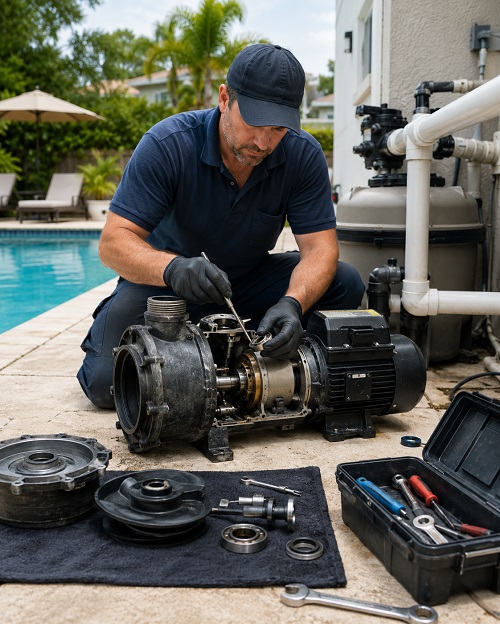
Pool pump repair in Melbourne starts with identifying why the existing pump is not starting, losing prime, leaking, becoming noisy or producing weak flow. Litra PoolCare checks the pump, suction side, visible valves and filtration behaviour before determining whether the fault can be repaired or whether replacement is more practical.
Different symptoms can have different causes. Pump noise, weak flow and prime loss can come from suction leaks, restrictions, valve position, mechanical seals, motor wear or filtration problems. These should be checked before parts are replaced.
Pump not starting
Humming, intermittent starting, repeated stopping or no normal startup.
Pump losing prime
The basket drains after shutdown or the pump struggles to refill when restarted.
Leak between motor and wet end
Water appears around the shaft or mechanical-seal area behind the pump body.
Loud motor or bearing noise
New whining, grinding, rattling or vibration during operation.
Weak flow
Pool returns feel noticeably weaker or circulation has fallen from its normal level.
Persistent air in the pump basket
Moving air, repeated loss of prime or worsening flow can point to a suction-side problem.
Priming and suction side
Water level, skimmer, lid seal, O-ring, visible suction fittings and valve position.
Pump components
Basket restriction, accessible impeller condition, mechanical-seal area and visible wet-end damage.
Motor behaviour
Startup behaviour, unusual motor noise, vibration, heat and visible evidence of moisture or deterioration.
Flow and filtration
Return flow and filter pressure are considered before poor circulation is attributed to the pump alone.
Repair, replacement or new pump installation?
Repair suits an existing pump with an isolated, repairable fault. Replacement becomes relevant when the pump is no longer economical to repair, while a new installation covers a new system or a change to the existing equipment setup.
Repair an existing pump
Repair is appropriate when an existing pump has developed a specific fault such as prime loss, a seal leak, motor noise, a startup problem or reduced flow and the remaining pump components are still in serviceable condition.
Replacement becomes more practical when the pump has structural damage, severe corrosion, repeated failures, unavailable parts or several worn components that would make another repair poor value.
A new pump installation is different from repairing an existing faulty pump. Installation work focuses on pump selection, plumbing compatibility, position, flow requirements and connection to the existing pool equipment.
Simple hydraulic causes should be ruled out before a motor or complete pump is condemned. The exact sequence depends on the symptom, but checking the system in a consistent order reduces the risk of replacing parts while an air leak, restriction or valve problem remains unresolved.
Water level and skimmer
Confirm that the pool water level keeps the skimmer opening adequately submerged and check that leaves, debris or a full skimmer basket are not restricting water reaching the pump.
Pump lid and O-ring
Check that the lid is seated correctly and inspect the O-ring for dirt, flattening, cracking or damage that can allow air into the suction side.
Basket and impeller restriction
A full pump basket or partially blocked impeller can reduce flow and cause noise, poor priming or low circulation without requiring complete pump replacement.
Suction-side air leak
Persistent moving air beneath the pump lid, difficult priming or prime loss after shutdown can indicate air entering through fittings, unions, valves or suction plumbing.
Valve position and water path
Suction and return valves are checked to make sure the intended water path is open and the pump is not being starved or restricted by an incorrect valve position.
Mechanical seal
Water appearing where the motor joins the wet end can indicate mechanical-seal failure. A continuing seal leak can allow moisture to reach motor-side components.
Motor and bearing condition
Grinding, whining, abnormal vibration, rough rotation or a noticeable change in motor sound is assessed separately from hydraulic noise caused by air or cavitation.
Flow and filter pressure
Return strength and filter pressure are considered together. A dirty filter or downstream restriction can reduce flow even when the pump itself is still operating correctly.
Variable-speed pump note:
a small, stable air space under the lid does not always indicate a fault when some variable-speed pumps are operating at low speed. Persistent moving air, repeated prime loss or declining flow is more significant and should be investigated.
More than one piece of equipment affected?
If the symptoms may involve the filter, chlorinator, plumbing, valves or several components on the equipment pad, see
pool equipment inspection and repair.
What different pump symptoms can point to
A symptom helps narrow the inspection, but it does not confirm the failed component on its own. Several different faults can produce similar pump behaviour.
Pump loses prime
Check water level, skimmer supply, pump-lid sealing, O-ring condition, suction fittings, valves and other possible suction-side air entry.
Leak between motor and wet end
Inspect the mechanical-seal area and surrounding pump components for evidence of seal failure, moisture tracking or associated corrosion.
Grinding or whining motor
Check whether the sound originates from the motor and bearings rather than from air, cavitation, debris, vibration or another hydraulic condition.
Weak return flow
Check the skimmer, pump basket, accessible impeller, suction path, valve positions, filter condition and filter pressure before blaming pump output alone.
Moving air under the lid
Persistent air can indicate suction-side air entry or a priming problem, particularly when it is accompanied by unstable flow or repeated loss of prime.
Pump hums but does not start
Motor startup and pump condition need assessment. Supply faults, hard-wired electrical faults or switchboard problems may require a licensed electrician.
Common pool pump repair problems
Pump will not start normally
A pump that is silent, hums, starts intermittently or stops repeatedly needs the pump-side fault separated from the electrical supply. Motor condition and startup behaviour can be assessed as part of pump diagnosis, while electrical installation faults may require a licensed electrician.
Pump loses prime after shutdown
Prime loss does not automatically mean the pump needs replacement. Low water level, the lid seal, O-ring, suction fittings, valves and other possible air-entry points should be checked first.
Water leaks behind the pump body
Water appearing where the motor meets the wet end often directs the inspection toward the mechanical-seal area. Continuing to operate a pump with an active seal leak can increase motor-side corrosion and bearing damage.
Pump becomes loud or rough
Worn motor bearings are one possible cause, but similar noise can come from air entering the system, cavitation, impeller problems or vibration through the equipment pad.
Pool circulation becomes weak
Reduced circulation can originate before the pump, inside the pump or downstream of it. The pump basket, impeller, suction line, valves, filter and return path all influence final flow.
Air remains visible through the lid
Stable operation with a small air space can be normal on some variable-speed systems at low speed. Moving bubbles, falling water level inside the pump, unstable flow or repeated prime loss are more useful fault indicators.
When to stop running the pump
Some symptoms justify switching the pump off rather than continuing normal filtration until the fault is checked. Continued operation can turn a smaller pump problem into motor, seal or wet-end damage.
Switch the pump off and arrange an assessment if:
the pump loses prime and continues running with little or no water in the strainer housing;
there is strong grinding, metallic contact or rapidly worsening mechanical noise;
the motor becomes abnormally hot or produces a burning smell;
the pump repeatedly trips an RCD, circuit breaker or overload protection;
water is leaking toward the motor or electrical section;
a cracked housing or fitting is releasing a significant amount of water.
When replacement is more practical
Replacing one failed component may not be worthwhile if the motor, wet end or housing already shows significant wear. The condition of the complete pump should be considered before investing in another repair.
Cracked wet end
Structural damage to the housing or other pressure-containing components can make reliable repair impractical.
Repeated motor failure
Recurring motor problems should prompt a check of the pump's overall condition and whether another motor-side repair is sensible.
Severe corrosion
Extensive corrosion, long-term water entry or deterioration around the motor can make further overhaul poor value.
Obsolete or unavailable parts
Some older or proprietary pump models become difficult to repair economically when essential seals, wet-end components or motor parts are no longer readily available.
Incorrect pump sizing
Repairing a pump that is poorly matched to the pool, plumbing or filter can restore operation without correcting the underlying hydraulic problem.
Several major faults together
Replacement may be more practical when the motor, wet end, seal area and other components all require significant work at the same time.
Clear photos can help identify the pump model, visible leaks, valve layout and equipment configuration before the visit. A short startup video can also be useful when the problem involves noise, vibration or slow priming.
Full equipment pad
Send one wide photo showing the pump, filter, chlorinator, visible valves and surrounding plumbing.
Pump label
Photograph the manufacturer label or compliance plate clearly enough for the model information to be read.
Lid and basket
Show the pump lid, basket area and any visible air in the pump while it is operating, where this can be photographed safely.
Leak close-up
Show the point where water first appears rather than only photographing water that has collected underneath the pump.
Valve layout
Include the suction and return valves so the normal water path through the equipment pad can be understood.
Short startup video
Record a brief startup where the problem involves slow priming, unusual noise, vibration, visible air or another symptom that changes once the pump is running.
Prime loss, weak flow and noise can originate from the water path as well as the pump motor. The first distinction is whether the symptom is being created by suction, filtration or an internal pump fault.
Is air entering the suction side?
Air under the lid, difficult priming and water draining after shutdown are assessed together with the lid seal, O-ring, valves and visible suction fittings.
Wet end, seal or motor?
The location of leaks, noise and vibration helps separate mechanical-seal problems, wet-end damage and motor-side faults that require different repairs.
Does filter pressure support the diagnosis?
Filter pressure and return flow provide useful context. A restricted filter or downstream problem can reduce circulation even when the pump is still capable of normal operation.
Pool pump repair FAQ
Can a pool pump be repaired on site?
Some pool pump faults can be diagnosed and corrected onsite, particularly where the problem involves priming, pump-lid sealing, accessible restrictions, valve position, plumbing connections or selected replaceable components. Repairs requiring motor disassembly or bearing work may require removal of the pump or motor. The repair method depends on the pump model and confirmed fault.
Why does a pool pump lose prime?
Prime loss can result from low pool water, an incorrectly sealing pump lid or O-ring, suction-side air entry, leaking fittings, valve problems or another condition that allows water to drain back after shutdown. These causes should be checked before the complete pump is replaced.
Is a leaking mechanical seal repairable?
The mechanical seal is replaceable on many pool pumps. Whether seal replacement is worthwhile depends on the condition of the shaft, seal plate, motor, wet end and other model-specific parts. A long-running seal leak can contribute to motor-side corrosion and bearing damage, so the surrounding components should be checked at the same time.
When is pool pump replacement better than repair?
Replacement is usually more practical when the wet end is cracked, corrosion is severe, the motor has failed repeatedly, essential parts are unavailable, several major components are worn or the existing pump is poorly matched to the pool system. See
pool pump replacement
for the replacement service.
Need a pool pump fault checked?
Send a wide photo of the equipment pad, the pump label and a close-up of any visible leak. Include your Melbourne suburb and describe what the pump is doing now compared with normal operation. If the fault involves noise, vibration or slow priming, a short startup video can also help with the initial assessment.
Service Area Map: South-East Melbourne, Nearby Bayside Suburbs & Selected Peninsula Areas
Tap a suburb chip to focus the map. We mainly service Carrum Downs, Frankston, Seaford, Chelsea, Patterson Lakes and nearby south-east suburbs, with selected Mornington Peninsula coverage.
Map shows the main service radius around Carrum Downs. Final visit availability still depends on suburb, access, and current workload.
Map could not load. Service areas include Carrum Downs, Frankston, Seaford, Chelsea, Patterson Lakes, Langwarrin, Skye, Edithvale, Aspendale, Mordialloc and nearby south-east suburbs.
Quick Pool Care Request
Cleaning, water testing, balancing or equipment support.
Same-day response
CleaningMaintenanceSkimmerFiltrationChlorineAlgaePumpBackwashVacuumpH LevelSanitizerBrushDebrisWater Test
CleaningMaintenanceSkimmerFiltrationChlorineAlgaePumpBackwashVacuumpH LevelSanitizerBrushDebrisWater Test


 Cleaning