

Repair the filter fault, not the symptom
Pool filter repair identifies serviceable faults in the filter, valve, pressure gauge, air-relief components, lid or clamp assembly, cartridges and media-filter internals before a full filter replacement is considered.
Litra PoolCare checks filter faults across its established south-east Melbourne service area when pressure is abnormal, a lid or valve is leaking, water is escaping to waste, filtration has deteriorated or sand and debris are returning through the pool jets.
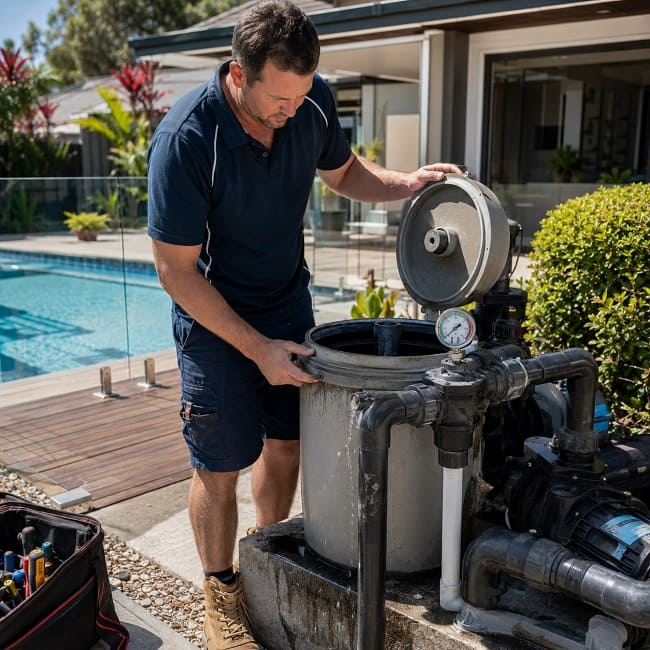
Do not open a pressurised pool filter
A pool filter is a pressure vessel. Never loosen a lid, clamp, lock ring, valve assembly or another pressure-retaining component while the pump is operating or pressure remains inside the filter.
Before a filter is opened for service, the circulation pump and automatic controls must be stopped, the system protected against an unexpected restart, and internal pressure released using the filter manufacturer's procedure. The pressure gauge must show zero before any pressure-retaining closure is touched.
If the tank, lid, clamp area or another pressure-retaining part appears cracked, distorted or structurally damaged, do not restart the filter simply to reproduce the fault. Arrange an inspection instead. A multiport valve should only be repositioned with the pump stopped.
Pool filter faults that may be repairable
We first confirm whether the fault is in the filter itself or elsewhere in the circulation system. Pump problems, blocked suction, air entering before the pump and incorrect valve positions can produce pressure and flow symptoms that resemble filter failure.
Water around a cartridge-filter lid or closure may come from a damaged or contaminated seal, incorrect seating or a serviceable closure component.
Water passing to the waste line while a media filter is operating in Filter mode can indicate internal valve leakage or a fault within the valve assembly.
After the system has been fully depressurised according to the filter manufacturer's procedure, a gauge that still does not return to zero may be faulty or have a blocked pressure connection. Gauge condition should be confirmed before its readings are used for diagnosis.
Repeated filter media at the return jets can point to damaged laterals, standpipe problems, incorrect media or an internal fault following previous filter work.
Torn pleats, damaged end caps, collapsed elements or damaged internal supports can allow debris to bypass effective filtration.
Leaking unions, drain fittings, valve connections and service seals can be assessed separately from cracks or structural damage to the pressure vessel.
High or low filter pressure is a clue, not a diagnosis
Pool filters do not all operate at one correct pressure. The useful reference is the pool's own clean-filter pressure at the same normal pump speed and valve arrangement. Pressure should be interpreted together with return flow and pump behaviour.
| Symptom | What it may indicate | What needs to be confirmed |
|---|---|---|
| Pressure is higher than the normal clean baseline | Filter restriction, a downstream restriction, incorrect valve position or changed pump operating conditions. | Whether the restriction is in the filter, valve arrangement or return side of the system. |
| Pressure rises again soon after normal servicing | Cartridges that remain restricted, a media problem, excessive debris load, restricted plumbing or a filter that is undersized for the operating flow rate. | Whether the next step is repair, cartridge replacement, media work or complete filter replacement. |
| Low pressure with weak return flow | Reduced pump output, a blocked basket, suction restriction, low water level, suction-side air entry or a pump priming or impeller problem. | Whether the loss of flow begins before water reaches the filter. |
| Gauge behaves abnormally | A failed gauge, blocked gauge connection or a reading that does not reflect actual operating pressure. | Gauge condition before pressure readings are used to judge the filter. |
Sand filter and cartridge filter repairs are different jobs
Media filters and cartridge filters use different internals and different cleaning systems. The repair path should follow the filter type rather than applying the same troubleshooting sequence to both.
Sand and glass-media filter faults
A media filter depends on the pressure vessel, media bed, laterals or collectors, standpipe, valve and backwash path working together. A fault in one of these areas can cause poor filtration, leaking to waste or filter media returning to the pool.
Water leaking to waste
Continuous waste-line flow while the valve is correctly set to Filter can point to internal multiport valve leakage. The valve and external waste path should be checked before the fault is attributed to the media.
Sand coming through the returns
Recurring gritty filter media can be associated with damaged laterals, a cracked or displaced standpipe, incorrect media or an internal assembly problem.
Filter or valve leaks
External leakage may come from unions, drain components, valve connections or service seals. Leakage from the tank itself requires a different assessment because the tank is part of the pressure vessel.
Fault remains after normal backwashing
If a correctly completed backwash and rinse does not restore expected filtration or flow, the next step is to determine whether the problem is internal damage, the media bed, the valve or another part of the circulation system.
Cartridge filter faults
Cartridge filters use removable pleated elements and a pressure-vessel closure rather than a backwashed media bed. Diagnosis therefore focuses on the cartridge elements, lid seal, closure system, pressure gauge, air relief, internal supports and tank condition.
Lid leaks after cartridge cleaning
Once the filter is safely depressurised, the O-ring, sealing surfaces, lid seating and closure components can be inspected. Repeatedly tightening a clamp or lock ring is not a substitute for finding the cause of the leak.
Damaged cartridge elements
Torn, collapsed or damaged elements can allow debris to bypass effective filtration. Cartridge replacement may be sufficient when the filter housing and closure remain serviceable.
Pressure rises quickly after cleaning
If properly cleaned cartridges remain restricted or pressure rises again quickly, cartridge condition, pump speed, debris load and the rest of the water path should be checked before another cleaning is recommended.
Leak from the tank or closure area
A serviceable seal leak is different from a cracked, distorted or damaged pressure-vessel component. Visible structural damage should not be treated as a routine O-ring repair.
Filter service and filter repair are not the same booking
Use filter repair when there is a specific fault
This service is intended for leaks, valve faults, abnormal gauge behaviour, damaged components, filter media returning to the pool and pressure or flow problems that remain after normal maintenance.
The assessment is used to locate the fault and determine whether the existing filter can be repaired or whether another service is more appropriate.
For cartridge cleaning, routine sand or glass-media servicing, filter cleaning and general filtration maintenance, use the dedicated filter service page.
View Pool Filter Service MelbourneWhat is checked before a filter part is replaced
Replacing a filter component before checking the surrounding circulation system can leave the original problem unresolved. The filter is therefore assessed together with the pump, flow, valves and visible plumbing.
Gauge behaviour
The pressure reading is compared with the pool's normal clean-filter baseline at the same pump speed. Gauge condition is also checked before the reading is relied on for diagnosis.
Return flow
Return strength is checked against pressure. Low pressure with weak flow may mean too little water is reaching the filter rather than excessive restriction inside it.
Filter condition
The filter model, visible tank condition, valve arrangement, unions, closure area and accessible service parts are reviewed before repair is recommended.
Pump and valve context
Pump priming, visible air, baskets, valve positions and accessible plumbing are considered because filter pressure cannot be interpreted accurately without the rest of the water path.
Repair, media replacement, full filter replacement or new installation?
These are different jobs. The correct option depends on the failed component, the condition of the pressure vessel, parts availability, filter sizing and whether the existing equipment remains practical to keep in service.
Repair the existing filter
Appropriate when the pressure vessel remains sound and the fault can be isolated to a serviceable valve, seal, gauge, closure component, cartridge component or accessible internal part.
Pool filter repair MelbourneReplace sand or glass media
Appropriate when the media-filter vessel remains suitable but the filtration problem is associated with the media bed or internal work that is best completed during a media change.
Pool filter media replacement MelbourneReplace the complete filter
More appropriate when the tank or housing is cracked, structurally damaged, repeatedly leaking, incorrectly sized, difficult to support with parts or no longer practical to keep repairing.
Pool filter replacementInstall a new filtration system
Used for a new installation or newly planned filter setup where filter type, pump flow, plumbing, backwash requirements and service access need to be matched as a complete system.
Pool filter installation MelbournePhotos to send before booking a filter repair
Clear external photos can help identify the filter model, valve layout and likely repair scope before the visit. You do not need to open or dismantle the filter for photographs.
Filter repair, replacement and diagnosis guides
Pool filter repair FAQ
Why has my pool filter pressure suddenly increased?
A sudden increase means resistance has changed somewhere in the operating system, but it does not prove that the filter itself has failed. Compare the reading with the normal clean-filter pressure at the same pump speed, then check return flow, filter condition and valve position.
Can a leaking cartridge filter lid be repaired?
Often, yes, when the tank and closure remain structurally sound and the fault is limited to a serviceable seal, sealing surface or closure component. The filter must be stopped and fully depressurised before the lid or clamp is inspected. A cracked or distorted pressure-vessel component should not be treated as a routine O-ring leak.
Why is sand coming back into my pool?
Repeated filter media at the return jets can indicate damaged laterals, a standpipe problem, incorrect media or an internal assembly fault. A continuing problem during normal filtration is different from a small amount of residual material immediately after previous media work.
Should I repair the filter or replace it?
Repair makes sense when the pressure vessel remains sound, the failed part can be identified and suitable parts are available. Full replacement is usually more appropriate when the tank or housing is cracked, structurally damaged, repeatedly leaking, incorrectly sized, obsolete or no longer practical to keep repairing.
Send the filter symptoms before replacing parts
Send your suburb, filter model, pressure-gauge photos, valve position, leak close-up and one wide photo of the equipment pad. Litra PoolCare can assess the likely repair scope and determine whether the next step is filter repair, cartridge or media work, full replacement or broader circulation diagnosis. Service availability is confirmed by suburb and job scope.