

Salt chlorinator installation matched to the pool and equipment
Litra PoolCare checks the pool volume, pump schedule, return plumbing, filter, heater, existing controls and the requirements of the selected chlorinator before fitting the controller and cell. Startup is completed against the model manual, with the water, flow protection and initial settings checked at handover.
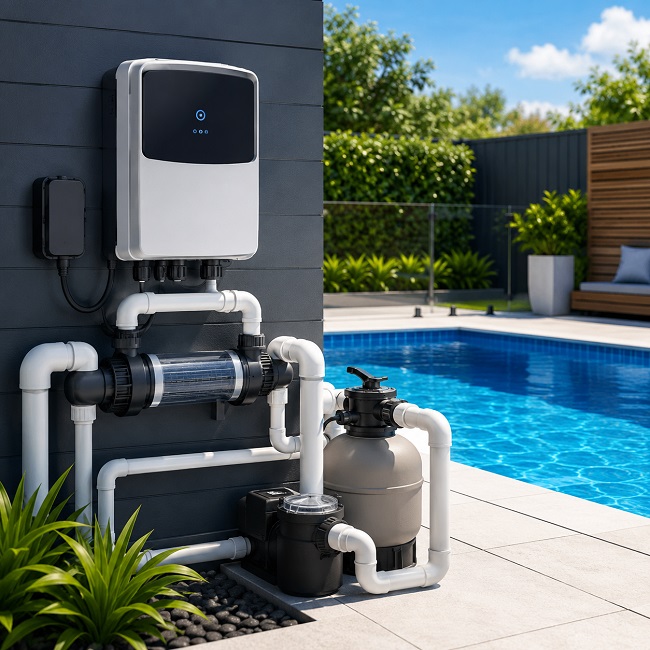
New installation, cell replacement or complete system replacement?
The correct scope depends on what is already installed, whether the controller still operates correctly and whether an approved replacement cell is available for that exact model.
New salt system installation
For a pool changing from manual or tablet chlorination, or for an equipment area with no usable salt controller and cell.
Cell-only replacement
A new cell may be enough when the controller is serviceable and the approved replacement matches the model, cable, unions and required chlorine output.
Complete matched replacement
A new controller and cell are usually considered when the old system is discontinued, undersized, repeatedly faulty or no longer supported by compatible parts.
What the installation service covers
Included in the pool-side scope
Quoted separately when required
How the chlorinator is selected
Pool volume is only the starting point. Chlorine output must also suit the time available for generation and the conditions that increase daily chlorine demand.
Compatibility and return-line position
Controller and cell pairing
The model number, approved cell family, output rating, connector, unions and control requirements are checked. A connector that fits physically does not prove electrical or control compatibility.
Position in the equipment line
The cell is placed from the installation diagram for the selected model, including its relationship to the filter, heater, dosing points, valves and other return equipment.
Orientation and flow direction
Horizontal or vertical mounting, flow-arrow direction, sensor position and required clearances are taken from the manual for that model rather than applied as a universal rule.
Protection when circulation stops
The chlorinator must not continue generating without confirmed water movement. The protection method may be an internal sensor, separate flow switch, pump interlock or model-specific automation.
Installation and commissioning sequence
Confirm the equipment and scope
Model labels, equipment photos, approximate pool volume, pipe layout, access and the existing power arrangement are checked before parts are ordered.
Fit the controller, cell and visible plumbing
The components are installed with the unions, orientation, clearances and service access required by the manufacturer.
Check the water before the cell is energised
Salt is verified against the model range. Newly added salt is allowed to dissolve and circulate for the period stated in that model’s startup instructions. Free chlorine and pH are also checked.
Test flow, startup and shutdown
The plumbing is checked for leaks, the pump and controller schedules are coordinated, and the low-flow protection and operating display are checked under normal circulation.
Record the handover settings
The starting output, pump runtime, salt reading, free chlorine and pH are recorded. The owner is shown how to test the pool and change one setting at a time.
Water conditions to correct before startup
Confirm salinity with a consistent independent test before adding more salt or switching on the cell.
Do not energise the cell until the salt has dissolved and circulated for the startup period specified by the manufacturer.
A new chlorinator should not be expected to recover a contaminated pool through normal gradual production.
Restore an appropriate starting chlorine level before handing the daily load to the cell.
Correct pH, alkalinity, stabiliser and calcium issues that could promote cell scaling or unstable chlorine.
Resolve dirty filtration, air entry, closed valves, weak return flow or a pump speed below the model requirement.
Brands and information needed for a quote
Neptune, AstralPool, Zodiac and Waterco are among the chlorinator brands encountered by Litra PoolCare. The model number still has to be checked because a brand name alone does not confirm cell compatibility, part availability or whether a discontinued system can be retained.
Photos to send
Include one wide photo of the full equipment area and clear close-ups of the controller display, model label, cell, unions, cable connection and surrounding return pipework.
Details to include
Provide the approximate pool volume, pump and filter models, normal pump schedule, recent salt and chlorine results, any error message, and whether heating or automation is installed.
What can change the quote or require another visit
Part availability
The controller, cell, unions, cable and manufacturer-specific accessories must be available as an approved combination.
Pipework and access
Crowded equipment areas, damaged valves, non-standard pipe sizes, poor access or insufficient straight pipe can increase the plumbing work.
Electrical preparation
New outlets, relocated power or fixed wiring must be completed before the chlorinator can be commissioned.
Water readiness
A second visit may be needed when salt still has to circulate, water requires treatment or commissioning cannot be completed under the model instructions.
Problems to separate before ordering a new chlorinator
Chlorine remains low while the display shows generation
Short runtime, low pump speed, heavy use, algae, debris, low stabiliser or poor circulation can consume chlorine faster than the cell replaces it.
Cell output has declined
Scale, coating wear, housing damage, incorrect salinity and controller faults need different remedies. See salt cell life and output decline.
Low Salt or No Flow warning
Compare the warning with an independent salt result, actual return flow, filter condition, pump speed and the sensor requirements for the exact model.
Corroded or overheated connection
Discoloured plugs, brittle insulation or damaged terminals should be inspected before another cell is connected. See salt cell cable and terminal corrosion.
Planning a salt chlorinator installation?
Send photos of the equipment area, controller, cell, model labels and visible pipework together with the approximate pool volume. This helps determine whether the job needs a new system, a cell-only replacement or a complete matched replacement.
Salt chlorinator installation FAQ
Can only the salt cell be replaced?
Yes, when the controller remains serviceable and an approved replacement cell matches the exact model, connection, unions and output requirement. A physical fit alone is not enough.
Does a licensed electrician need to attend?
Not every installation needs new electrical work. A new power point, relocated outlet, hard-wired connection or other fixed wiring must be completed by a Registered Electrical Contractor using a licensed electrician.
Where is the salt cell installed?
It is fitted in the return plumbing according to the layout, orientation, clearances and flow requirements for the selected model. The filter, heater, dosing points, valves and controls must be considered in that layout.
How is the correct chlorinator size selected?
Pool volume is only the starting point. Rated output in g/hr, realistic daily runtime, sun, water temperature, swimmer load, cover use and the manufacturer’s sizing guidance are considered together.
Can commissioning always be completed on the installation day?
Not always. Electrical preparation, undissolved salt, water treatment, missing parts or a model-specific startup requirement can make a return visit necessary.